
Exploring Ghanaian Folklore Through Literature
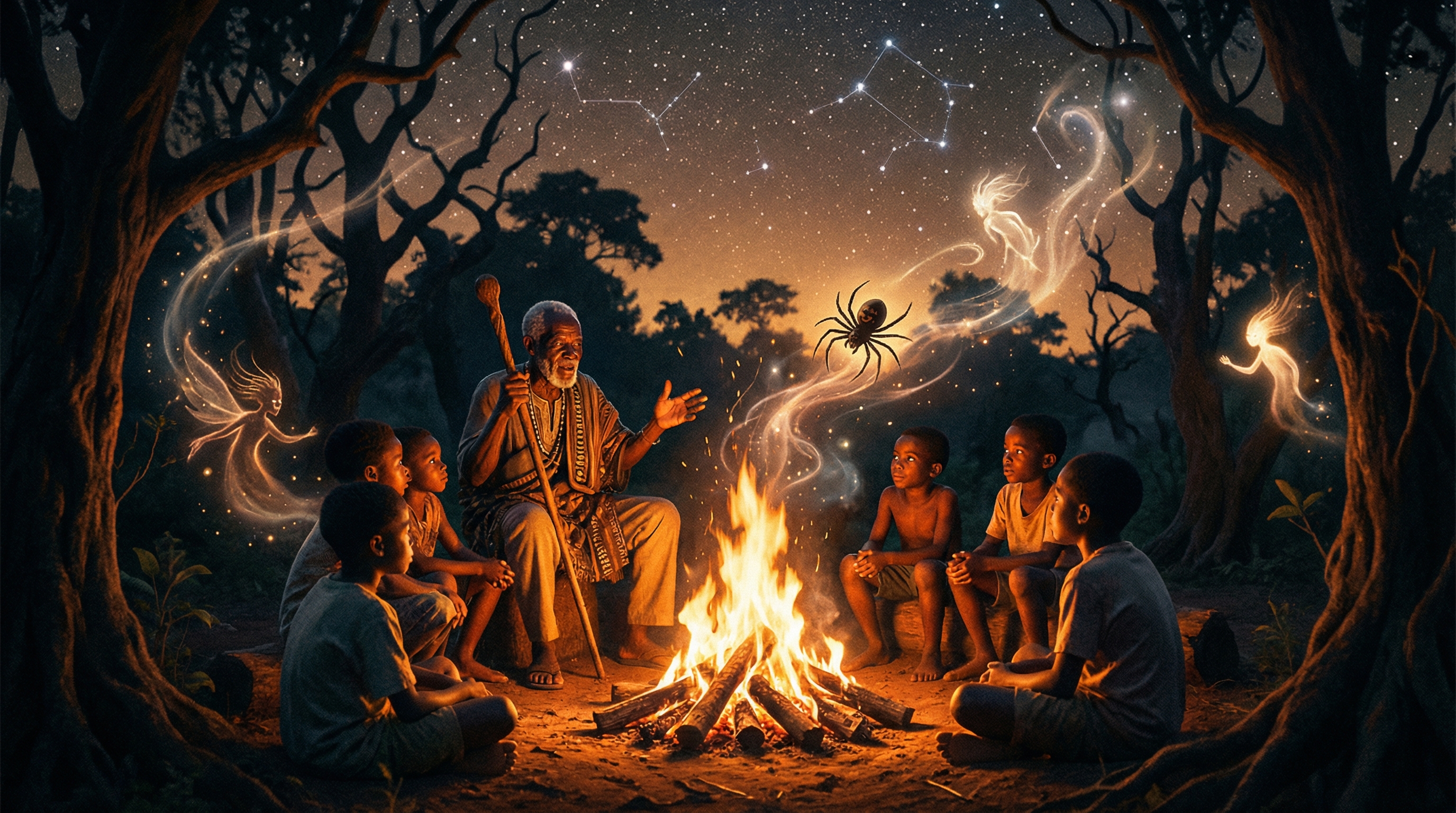
Before Ghana had novelists, it had storytellers. Before it had printing presses, it had griots and elders who carried entire histories in their memory, performing them for communities gathered around fires or in courtyards after the day's work was done. These stories were not entertainment in the modern sense. They were education, moral instruction, history, and philosophy, all woven together into forms that could be remembered, repeated, and passed on.
Ghanaian folklore is the deep root system from which all Ghanaian literature grows. Understanding it transforms your reading of Ghanaian novels, poetry, and drama -- because the best Ghanaian writers have never stopped drawing from that well.
Anansi: The Spider Who Owns All Stories
The most internationally recognised figure from Ghanaian folklore is almost certainly Anansi -- the spider trickster of the Akan people. Anansi is cunning, clever, and morally ambiguous. He is a survivor. He uses his wits to outmanoeuvre larger, stronger opponents, and his methods are not always honourable.
In the original Akan tradition, Anansi is not just a character in stories. He is the owner of stories. According to tradition, before Anansi bargained with the Sky God Nyame to purchase all the world's stories, tales belonged to no one and floated freely. Anansi gathered them and became their keeper. This is why Akan folk tales are sometimes called "Anansesem" -- "spider stories."
The Anansi stories traveled with enslaved Ghanaians to the Caribbean and the Americas, where they took on new forms. In the Caribbean, Anansi became a symbol of resistance -- the small, clever figure who outsmarts the powerful -- and his stories were told as acts of cultural survival. In America, he became Brer Rabbit. In Haiti, he became a figure in the vodou tradition.
Tracing Anansi's journey across the Atlantic is itself a lesson in the history of the African diaspora. The spider's thread, in a very real sense, connects Ghana to Jamaica, to the American South, to Brazil.
Folklore and the Novel: How Writers Use Tradition
Ghanaian novelists have always been in conversation with the folklore tradition, sometimes explicitly and sometimes through the deeper logic of their narratives.
Ayi Kwei Armah's novels are full of the symbolic vocabulary of Akan thought. In "The Beautyful Ones Are Not Yet Born," the moral corruption Armah describes is figured through imagery of rot, stench, and contamination that echoes the Akan concept of "sunsum" -- the spirit or essence of a person or a community. When that essence is corrupted, the whole body suffers.
Ama Ata Aidoo draws on the oral tradition more explicitly. Her prose often shifts without warning between voices, incorporating the kind of choral address that characterises oral performance. In "Our Sister Killjoy," the narrator sometimes addresses the reader directly, sometimes steps back, sometimes speaks in what feels like a communal voice -- "we" rather than "I." This is the structure of oral storytelling translated onto the page.
Efua Sutherland, one of Ghana's great playwrights, made the connection between oral tradition and literary theatre explicit. Her play "The Marriage of Anansewa" is a direct reworking of Anansi folk tales into modern theatrical form, using the tradition of the "storyteller" figure who addresses the audience directly and breaks the fourth wall.
The Role of Proverbs
Akan culture has a rich proverb tradition, and these proverbs function in Ghanaian literature much the way biblical allusions function in European literature -- as shared reference points that carry layers of meaning for readers who know them.
When an Akan elder says "Onipa na ohwehwe onipa" -- "It is a person who looks for another person" -- they are invoking an entire philosophy of community and mutual dependence. When a Ghanaian novelist uses this phrase or alludes to the values it encodes, they are drawing on that philosophy without having to explain it.
The Sankofa symbol itself is a proverb in visual form: "It is not wrong to go back for what you forgot." Understanding this proverb helps you understand why Ghanaian literature so often returns to history, to the past, to origins -- not as nostalgia, but as a philosophical commitment to learning from what came before.
Funeral Traditions and Literature
Death and mourning occupy an unusual place in Ghanaian cultural life. Ghanaian funerals are famous outside Ghana as celebrations -- elaborate, expensive, joyful in their music and colour even as they mourn the deceased. This is not a contradiction. In Akan thought, death is not an ending but a transition. The ancestors are present, active, and capable of influencing the lives of the living.
This relationship with the dead shows up throughout Ghanaian literature. In Ayi Kwei Armah's "Two Thousand Seasons," the ancestors are literally voices in the text -- a chorus of the dead speaking to the living about what has been lost and what must be recovered. In Ama Ata Aidoo's work, the past is never simply past.
Folklore as Living Culture
One mistake that readers sometimes make is treating folklore as something ancient and finished -- a tradition that ended when modernity began. In Ghana, this is simply not true.
Ghanaian popular culture continues to draw on folklore. Highlife music, one of Ghana's great contributions to world music, incorporates storytelling traditions and moral philosophy from the oral tradition. Kente cloth patterns tell stories through their design. The language of contemporary Ghanaian politics still draws on proverbs and folk wisdom.
And contemporary Ghanaian writers continue to engage with the tradition. Writers like Nana Darkoa Sekyiamah, whose memoir-essay "The Sex Lives of African Women" engages with questions of identity and desire in ways that both challenge and draw on Ghanaian cultural frameworks, are proof that the conversation between folklore and contemporary literature is ongoing.
Exploring Further with Sankofa Library
The Sankofa Library catalog includes collections of Akan folk tales, critical studies of Ghanaian oral tradition, and the literary works that grew from it. If you want to understand Ghanaian literature at its deepest level, start with the stories. Start with Anansi. Follow the spider's thread, and see where it leads.