
The History and Meaning of Sankofa in Ghanaian Culture
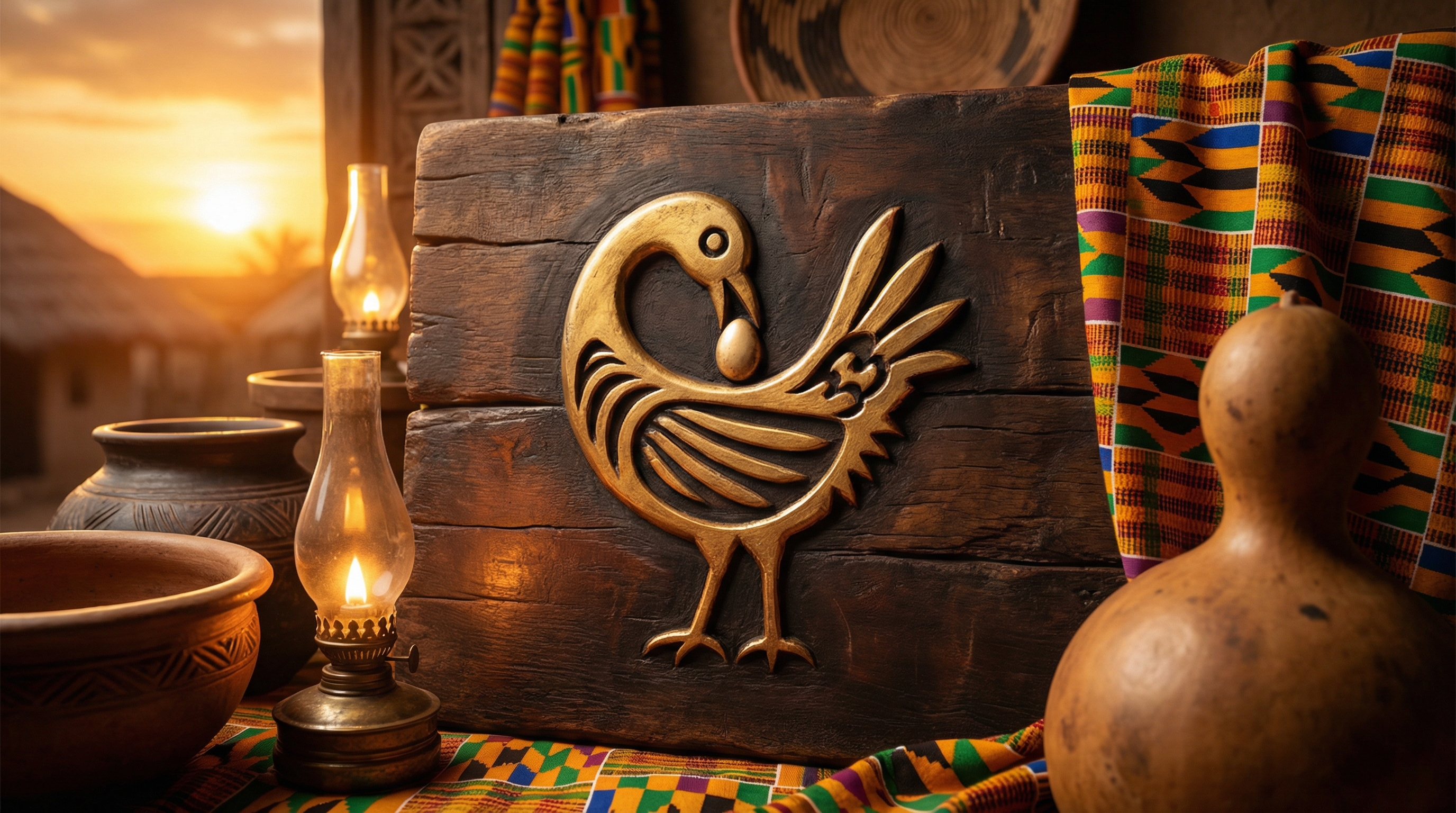
There is a bird in Akan tradition that flies forward while looking backward. Its neck is turned over its shoulder. In its beak, it carries an egg -- the future, cradled carefully even as its gaze holds the past. This bird is called Sankofa, and the image it represents is one of the most profound philosophical ideas to emerge from Ghanaian culture.
Sankofa is not just a symbol. It is a way of understanding time, identity, and the responsibility that comes with knowledge.
The Origins of Sankofa
The word Sankofa comes from the Twi language, spoken by the Akan people of Ghana and parts of Ivory Coast. It is a compound word: "san" (to return), "ko" (to go), and "fa" (to fetch or seek). Together, the phrase translates roughly as: "Go back and fetch it."
In full, the Akan proverb reads: "Se wo were fi na wosankofa a yenkyi" -- meaning, "It is not wrong to go back for what you forgot." The idea embedded in this proverb is that returning to retrieve something of value from the past is not weakness. It is wisdom.
Sankofa is one of the Adinkra symbols -- a system of visual symbols developed by the Akan people and used on cloth, pottery, architecture, and ceremonial objects. Each Adinkra symbol encodes a concept, a proverb, or a value. They function as a kind of philosophical shorthand, allowing complex ideas to be communicated through image rather than text.
The Sankofa symbol has two common visual forms. The first is the bird with its head turned backward, carrying an egg. The second is a heart shape -- stylised and abstract, but equally recognised. Both representations carry the same meaning: the importance of learning from the past to build a better future.
Adinkra: A Living Language of Symbols
To understand Sankofa fully, it helps to understand the broader Adinkra tradition from which it comes.
Adinkra symbols were originally created by the Gyaman people of what is now Ghana and Ivory Coast, and were later adopted and developed by the Asante. Historically, Adinkra cloth was worn at funerals and other solemn occasions -- printed with symbols that spoke to mortality, loss, and the relationship between the living and the dead.
Over time, Adinkra symbols have expanded beyond funeral contexts. Today they appear on everything from government buildings to university logos to everyday clothing. They have been adopted internationally as expressions of African cultural identity, appearing on album covers, tattoos, and wall art around the world.
Among all the Adinkra symbols, Sankofa has perhaps traveled furthest. It has become a touchstone for discussions of African history, diaspora identity, and cultural recovery.
Sankofa and the African Diaspora
One reason Sankofa resonates so powerfully across the African diaspora is that it speaks directly to the experience of people whose connection to their African heritage was violently severed.
The transatlantic slave trade did not only transport people. It destroyed languages, religions, family structures, and cultural knowledge accumulated over thousands of years. For the descendants of enslaved Africans in the Americas and the Caribbean, the question of how to reclaim what was taken -- how to "go back and fetch" what was lost -- is not abstract. It is intensely personal.
Sankofa offers a framework for this work. It says that returning to the past is not about living there. It is about understanding what was valuable, what was lost, and what can be carried forward. The egg in the bird's beak is the key image: you return to the past not to stay there, but to carry something into the future.
This is why Sankofa has become so central to African-American cultural and educational movements, from Afrocentric pedagogy in the 1980s and 1990s to contemporary discussions of reparations and historical justice.
Sankofa in Ghanaian Education and National Identity
Within Ghana, Sankofa is deeply embedded in educational philosophy. The idea that students must understand Ghanaian history, culture, and values before they can contribute meaningfully to the country's future is a recurring theme in Ghanaian educational discourse.
This is one reason that literature, history, and cultural studies occupy a prominent place in Ghanaian curricula. Reading Ama Ata Aidoo, learning about the Asante empire, studying the independence movement and Kwame Nkrumah's Pan-African vision -- these are acts of Sankofa. They are the process of going back to fetch what is needed for the journey forward.
Ghanaian scholars and cultural figures have also used Sankofa as a lens for critiquing what they see as uncritical adoption of Western values and practices at the expense of indigenous knowledge systems. The argument is not that Ghana should reject modernity, but that modernity should be built on a foundation of genuine self-knowledge.
Sankofa and the Sankofa Library
The name of this library is not accidental. A library is itself an act of Sankofa -- a gathering and preservation of knowledge from the past so that it can be accessed, built upon, and carried into the future.
The Sankofa Library's catalog of African literature, history, and thought is grounded in the belief that knowledge of Africa's literary and intellectual heritage is not optional for Africans, or for anyone who wants to understand the world honestly. The stories are here. The histories are here. The philosophical frameworks are here.
The bird is already in flight. Its head is already turned. The egg is already in its beak.
The only question is whether you are ready to receive what it carries.
Further Reading
The Sankofa Library catalog includes works on Adinkra symbolism, Akan philosophy, and the history of the Asante kingdom. For readers who want to go deeper into the ideas explored in this article, we recommend starting with works on Akan thought and cultural history, and pairing them with the novels of Ama Ata Aidoo and Ayi Kwei Armah -- writers whose work embodies Sankofa in its deepest sense.