Keyboard shortcuts
- J: Next chapter
- K: Previous chapter
- T: Toggle table of contents
- Shift+S: Share book
- +: Increase font size
- -: Decrease font size
- Escape: Close modals
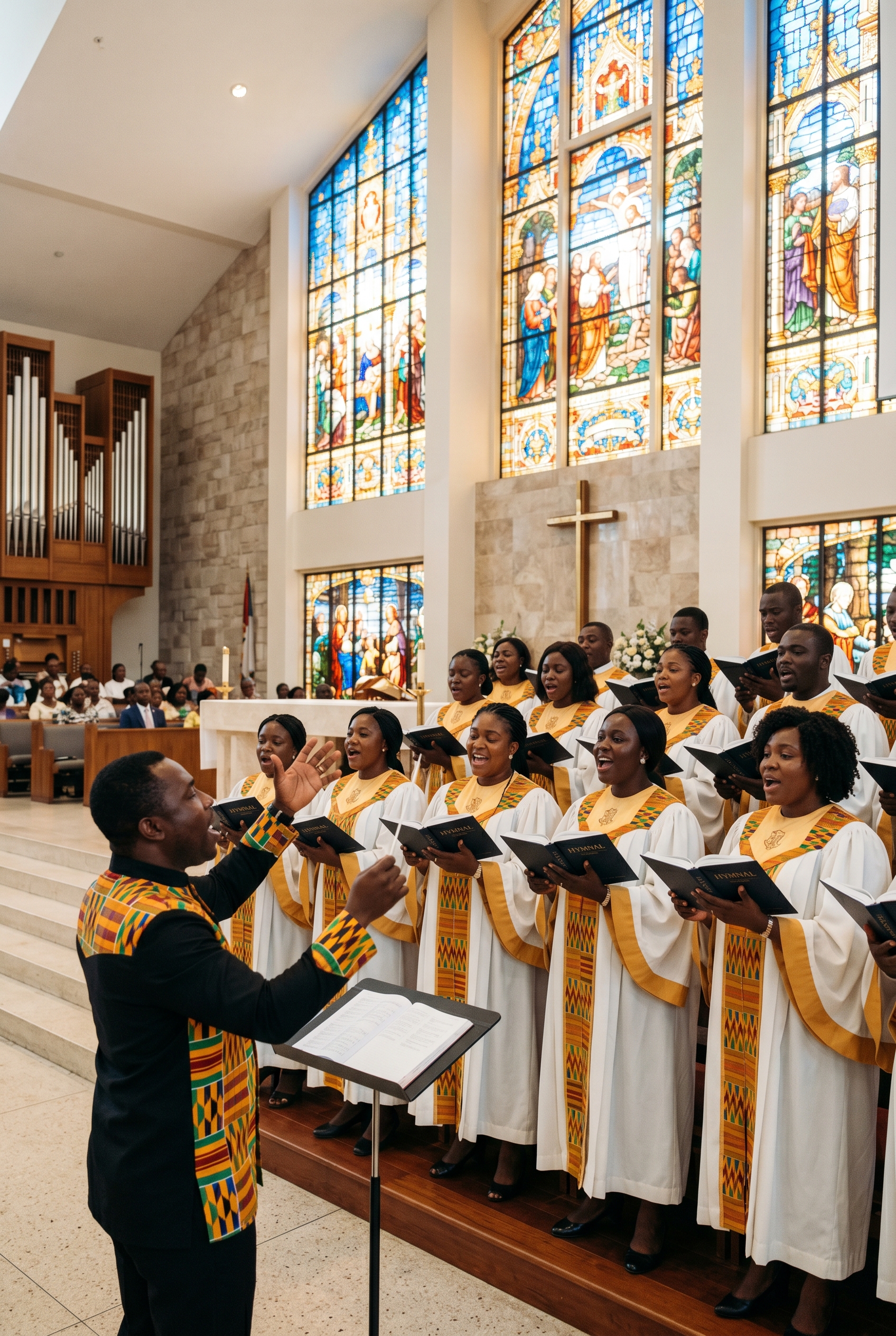
Resounding Faith and Nationhood: The Evolution of Choral Music in Modern Ghana
- Christian Missions
- Ghanaian Music
- National Identity
- Church Music
- Ephraim Amu
- Independence Movement
- Kwame Nkrumah
- Cultural Preservation
- Gospel Music
- Choral Composition
Chapter 1
The Seed of Song: Missionary Influence and Early Choral Traditions (1900-1940s)
The dawn of the 20th century solidified the presence of Christian missions across the Gold Coast, profoundly shaping its cultural and musical landscape. While missionaries from the Basel, Wesleyan, and Catholic churches had been active since the mid-19th century, the early 1900s saw their educational and religious institutions firmly established, with choral singing at the heart of their evangelistic efforts. Western hymns, often sung in four-part harmony, became ubiquitous in churches and schools, introducing a new sonic aesthetic to communities primarily accustomed to monophonic or responsorial indigenous musical forms. Figures like Rev. Thomas Birch Freeman of the Wesleyan Mission and the German missionaries of the Basel Mission were instrumental in this initial phase, not only by introducing European music but also by encouraging the translation of hymns into local languages such as Ga, Twi, Ewe, and Fante.
This period was characterized by a delicate balance between assimilation and nascent adaptation. While the musical structures remained largely European, the linguistic shift was significant, allowing congregants to connect with the spiritual messages in their mother tongues. The training of local catechists and teachers, often at institutions like the Akropong Training College (established 1848 by the Basel Mission) and Wesley College, Kumasi (established 1922), created a cadre of individuals capable of leading choirs and disseminating these new musical practices. These early efforts laid the foundational stones for what would become a distinct Ghanaian choral tradition, blending the solemnity of Western sacred music with the inherent musicality of the Ghanaian people.
However, the music of this era was still largely imitative, with little deviation from European melodic and harmonic conventions. The challenge was to move beyond mere translation and create music that truly resonated with the Ghanaian spirit. This groundwork, though, was crucial. It familiarized communities with choral singing, developed basic musical literacy among a segment of the population, and inadvertently set the stage for a later generation of composers who would boldly fuse these imported traditions with the rich indigenous musical heritage of Ghana. The widespread adoption of these hymns in schools meant that generations grew up with an understanding of choral harmony, preparing fertile ground for future innovations.
Sources & References
- Nketia, J. H. Kwabena. The Music of Africa. W. W. Norton & Company, 1974.
- Amu, Ephraim. Twenty-Five African Songs. Oxford University Press, 1932.
- Kwami, Robert. 'Choral Music in Ghana.' The Garland Encyclopedia of World Music, Vol. 1: Africa. Routledge, 1998.
- Brempong, O. 'The Development of Choral Music in Ghana.' University of Ghana, Legon, 1986 (unpublished dissertation).