Keyboard shortcuts
- J: Next chapter
- K: Previous chapter
- T: Toggle table of contents
- Shift+S: Share book
- +: Increase font size
- -: Decrease font size
- Escape: Close modals
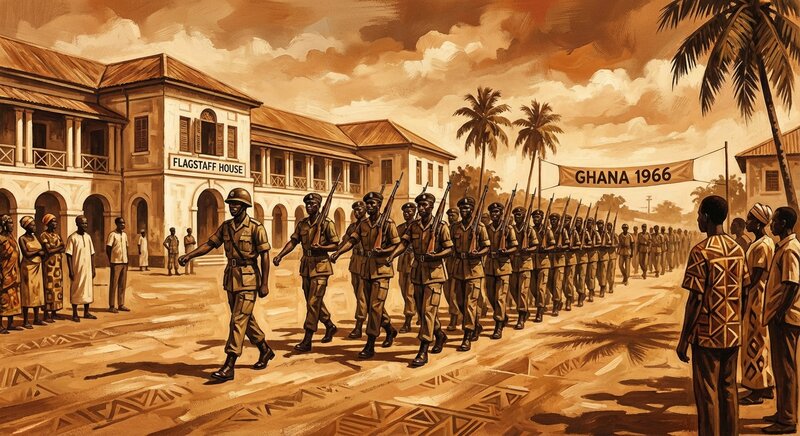
The Ides of February: Ghana's 1966 Coup and the Unraveling of Nkrumah's Vision
- Kwame Nkrumah
- 1966 Coup
- Operation Cold Chop
- National Liberation Council (NLC)
- Ghana First Republic
- Military Rule
- Pan-Africanism
- Convention People's Party (CPP)
- Joseph Arthur Ankrah
- Emmanuel Kwasi Kotoka
- Accra
Chapter 1
The Nkrumah Years: Aspirations and Discontents (1957-1966)
When Ghana gained independence on March 6, 1957, Kwame Nkrumah stood as the beacon of African liberation. "We prefer self-government with danger to servitude in tranquility," he had declared, echoing a sentiment that resonated across the continent. The early years brought ambitious projects: the Akosombo Dam, free education, industrialization drives, and the grandest pan-African vision the continent had seen.
But by the early 1960s, cracks were showing. The Convention People's Party (CPP) had morphed from a liberation movement into an instrument of control. The Preventive Detention Act of 1958 allowed imprisonment without trial for up to five years, a tool wielded liberally against opposition figures like J.B. Danquah, who would die in detention at Nsawam Prison in February 1965. In 1964, a heavily rigged constitutional referendum made the CPP the sole legal party and Nkrumah president for life.
The economy was buckling under the weight of prestige projects and mounting foreign debt. Cocoa farmers, once the backbone of the economy, watched their earnings shrink as the Cocoa Marketing Board siphoned profits. Consumer goods became scarce, prices soared, and the cedi lost value rapidly. As the Ghanaian Times declared in October 1965: "Our socialist society cannot, and would not, tolerate the publication of any newspaper which departs from the ideology and loyalties demanded from the press in socialist and Nkrumaist Ghana."
General Afrifa would later reflect on Radio Ghana's broadcasts: "From early morning till late at night there poured forth a sickening stream of Stalinist adulation and abject flattery. News was so often distorted or suppressed that Ghanaians stopped believing what they heard." The stage was being set for a reckoning.
About This Book
"The Ides of February" meticulously dissects the intricate web of factors culminating in the 1966 coup, a pivotal event that irrevocably altered Ghana's trajectory and resonated across the African continent. The book chronicles the unraveling of Kwame Nkrumah's ambitious vision for a socialist, unified Africa, meticulously examining the economic policies, such as the Seven-Year Development Plan, that, while aiming for rapid industrialization, simultaneously strained the Ghanaian economy and fostered widespread discontent. It delves into the controversial Preventive Detention Act, a tool used to suppress political opposition, highlighting its impact on civil liberties and the erosion of democratic principles under the Convention People's Party (CPP) regime. The narrative meticulously reconstructs the events of February 24th, 1966, detailing the strategic planning and execution of Operation Cold Chop by key figures like Colonel Kotoka, Commissioner Harlley, and Major Afrifa. It sheds light on the motivations driving these actors, analyzing the confluence of personal ambition, ideological differences, and perceived national interests that fueled their actions. The book also examines the international context, exploring the role of Cold War rivalries and the potential involvement of external powers, such as the United States, in undermining Nkrumah's increasingly socialist and anti-imperialist stance. It analyzes the immediate aftermath of the coup, focusing on the establishment of the National Liberation Council (NLC) and its initial policies, including the reversal of Nkrumah's socialist agenda and the realignment of Ghana's foreign policy with the West. Ultimately, the book provides a nuanced and comprehensive analysis of the 1966 coup, moving beyond simplistic narratives of betrayal or foreign interference. It offers a critical examination of Nkrumah's legacy, acknowledging his contributions to Pan-Africanism and Ghanaian independence while also confronting the shortcomings of his authoritarian rule and economic policies. The reader gains a deeper understanding of the complex political, economic, and social dynamics that shaped Ghana in the post-independence era and the lasting consequences of the coup for Ghanaian democracy and development.
About the Author
The study of Ghana's 1966 coup has been a subject of intense debate and diverse interpretations, beginning almost immediately after the event itself. Early accounts, often aligned with the NLC, focused on the alleged excesses of Nkrumah's regime and the necessity of the intervention. Later scholarship, particularly from Pan-Africanist perspectives, emphasized the role of external forces and the betrayal of Nkrumah's vision. Historians such as Basil Davidson and Richard Wright offered early critiques of colonialism's lingering effects on African nations, indirectly influencing subsequent analysis of Nkrumah's downfall. More recently, scholars like Emmanuel Kwaku Akyeampong and Joseph Ayee have contributed nuanced perspectives, examining the internal contradictions within the CPP and the broader socio-economic context. This book stands on the shoulders of these scholars, drawing from archival research, oral histories, and critical analyses to offer a comprehensive understanding of the coup and its lasting impact.
Key Themes
- Military intervention in politics
- Economic development models
- Cold War influence in Africa
- Pan-Africanism and its discontents
- Political repression and civil liberties
- The legacy of Kwame Nkrumah
Why This Matters
The 1966 coup remains a watershed moment in Ghanaian history, casting a long shadow over the nation's political development. It marked the end of Ghana's first republic and ushered in an era of military rule and political instability that plagued the country for decades. Understanding the causes and consequences of the coup is crucial for comprehending the challenges that Ghana has faced in consolidating its democracy and achieving sustainable development.
For the African diaspora, this event serves as a cautionary tale about the fragility of post-colonial states and the dangers of authoritarianism. It prompts reflection on the complex legacy of Pan-Africanism and the challenges of realizing its ideals in the face of internal divisions and external pressures. For students, particularly those studying African history and political science, the 1966 coup offers a valuable case study for examining the dynamics of regime change, the role of the military in politics, and the impact of Cold War rivalries on African nations. It underscores the importance of good governance, respect for human rights, and inclusive economic development in building stable and prosperous societies.
Historical and Cultural Context
The 1966 coup in Ghana occurred within a broader context of political instability and military interventions across Africa in the 1960s. From Nigeria to Algeria to the Congo, newly independent nations faced challenges of nation-building, economic development, and political consolidation, often resulting in military coups. This period witnessed the rise of strongman rule and the suppression of democratic institutions across the continent, challenging the initial optimism that accompanied independence. Within the Sankofa Library, this book can be read in conjunction with texts exploring the rise and fall of other post-colonial African leaders, providing a comparative perspective on the challenges and opportunities of the independence era.
Sources & References
- Afrifa, A.A. The Ghana Coup: 24th February 1966. Frank Cass, 1966.
- Stockwell, John. In Search of Enemies: A CIA Story. W.W. Norton, 1978.
- Boahen, A. Adu. The Ghanaian Sphinx: Reflections on Contemporary History. Sankofa Educational Publishers, 1989.
- Encyclopaedia Africana: Kotoka, Emmanuel Kwasi. 2025.
- Wikipedia: 1966 Ghanaian coup d'état. Accessed February 2026.
- Reindorf, Carl Christian. History of the Gold Coast and Asante. Basel, 1895.