Keyboard shortcuts
- J: Next chapter
- K: Previous chapter
- T: Toggle table of contents
- Shift+S: Share book
- +: Increase font size
- -: Decrease font size
- Escape: Close modals
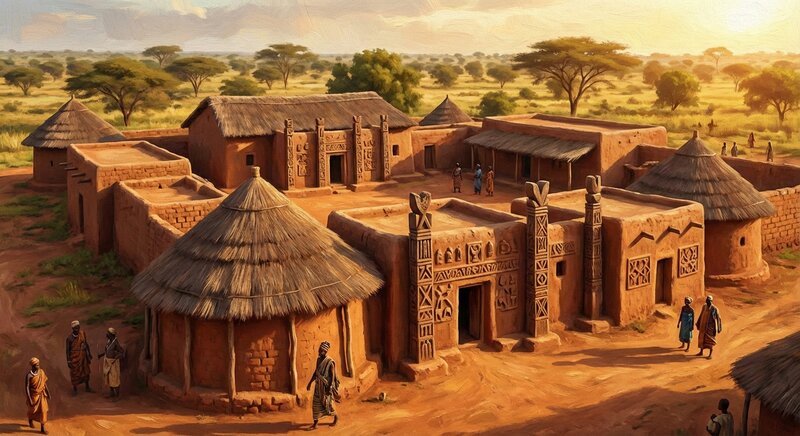
The Lion's Roar and the Drum's Echo: Unraveling the Pre-Colonial Dagbon Kingdom of Northern Ghana
- Dagbon Kingdom
- Ya-Na
- Naa Gbewaa
- Lunsi
- Drum History
- Northern Ghana
- Chieftaincy
- Gonja Wars
- Yendi
- Mole-Dagbani
Chapter 1
The Genesis of Power: Naa Gbewaa and the Founding Myths of Dagbon
The Kingdom of Dagbon (Dagbani: Dagbaŋ) is one of the oldest and most organised traditional kingdoms in Ghana, with roots stretching to the 13th or 14th century. Its founding narrative, preserved by the Lunsi (court griots), traces the royal lineage to Tohaʒee (the Red Hunter), a warrior who led a small band of cavalry from Tunga, east of Lake Chad, through Zamfara in present-day northern Nigeria, and eventually into the territories of the Mali Empire.
Tohaʒee's descendants — through his son Kpuɣnambo — eventually produced Naa Gbewaa, the patriarch who unified the Dagomba and related Mole-Dagbon peoples. Before Gbewaa's consolidation, the region was governed by decentralised earth priests called Tindaamba (singular: Tindana), who oversaw spiritual and religious matters — pacifying earth gods (tingbana), deities (bina), and shrines (buga). Archaeological evidence suggests thriving civilisation in the Dagbon region even before the Neolithic period, with evidence of agriculture and iron-smelting industries.
Naa Gbewaa established his authority at Pusiga (in present-day Upper East Region) around the late 14th century. His sons went on to found the great northern kingdoms: Naa Sitobu founded Dagbon proper; Tohugu founded the Mamprugu (Mamprusi) kingdom; and a daughter, Yennenga (known in Dagbani as Yɛmtɔri), is celebrated as the "mother" of the Mossi kingdoms of Burkina Faso after marrying a hunter named Riale (or Ouadrago). This makes Dagbon a cradle of state formation for much of the West African savanna — the Dagomba, Mamprusi, Nanumba, and Mossi all trace their ruling dynasties to Gbewaa's lineage.
The early Dagbon state was fundamentally a cavalry kingdom. Horses — introduced through Saharan trade networks — gave Gbewaa's descendants a decisive military advantage over the acephalous farming communities of the Volta basin. The fusion of incoming cavalry elites with indigenous Tindaamba created Dagbon's distinctive dual governance system: chiefs held political and military power, while Tindaamba retained spiritual authority over the land.
About This Book
"The Lion's Roar and the Drum's Echo" offers a comprehensive examination of the pre-colonial Dagbon Kingdom, tracing its origins from the mythical figure of Naa Gbewaa, whose legacy extends to other prominent kingdoms in Northern Ghana. The book meticulously chronicles the kingdom's evolution, detailing the intricate processes of state formation, expansion, and consolidation that transpired over centuries. A key focus is on the Ya-Na, the paramount ruler, and the complex system of succession that often involved intense rivalries among royal lineages. The book unpacks the significance of Yendi, the Dagbon capital, as the political and spiritual heart of the kingdom, a center of power, diplomacy, and cultural expression. The narrative delves into the kingdom's sophisticated political structure, highlighting the roles and responsibilities of various chieftaincies, from the powerful divisional chiefs to the village heads. It illuminates the mechanisms of governance, land tenure, and justice administration, showcasing the Dagbon people’s ability to create a stable and prosperous society. The book also addresses Dagbon's economic foundations, examining its agricultural practices, trade networks (particularly with the Hausa states and Asante), and the role of crafts and industries. Furthermore, the book explores Dagbon's rich cultural tapestry, focusing on its unique traditions, customs, and religious beliefs. It examines the significance of oral traditions, music, dance, and festivals in preserving and transmitting Dagbon's history and values. The book analyzes Dagbon's military prowess, its strategies for defense against external threats, and its interactions with neighboring kingdoms. It concludes by examining the impact of colonial intrusion on the Dagbon Kingdom, particularly the events leading up to the Anglo-Dagbon War and its subsequent incorporation into the Gold Coast. This book paints a picture of a complex and dynamic society that shaped Northern Ghana and its relationship to its neighbors.
About the Author
The study of Dagbon history rests on a foundation built by generations of oral historians (kpamba) and more recently, academic researchers. Notable early contributions came from anthropologists and colonial administrators who, while often biased, documented valuable oral accounts and traditions. Figures such as A.W. Cardinall and R.S. Rattray, in their broader studies of the Gold Coast, touched upon aspects of Dagbon history and social organization. Ivor Wilks' work on Asante also illuminated Asante-Dagbon relations. More recently, scholars like David Tamari and Martin Staniland have brought fresh perspectives, focusing on political dynamics, chieftaincy, and the impact of colonialism. This book synthesizes these existing works, combining archival research with insights from contemporary Dagbon scholars to provide a more nuanced and comprehensive understanding of the kingdom.
Key Themes
- Kingdom building
- Succession disputes
- Political organization
- Cultural preservation
- Economic systems
- Oral tradition
- Colonial impact
Why This Matters
Understanding the Dagbon Kingdom is crucial for grasping the complexities of Ghanaian and West African heritage. Dagbon's pre-colonial institutions, such as its chieftaincy system and governance structures, continue to influence contemporary Ghanaian politics and social life. The kingdom's history provides valuable insights into the processes of state formation, inter-ethnic relations, and resistance to colonial rule in the region.
For the African diaspora, the story of Dagbon offers a tangible connection to a rich and sophisticated African past, countering narratives of statelessness and primitivism. The kingdom's achievements in governance, trade, and cultural expression demonstrate the agency and ingenuity of African societies before colonial intervention. Students, in particular, can learn from Dagbon's example how African societies developed complex systems of social organization, adapted to their environments, and resisted external domination. Engaging with Dagbon's history is an act of reclaiming and celebrating African heritage, promoting a more balanced and informed understanding of the continent's past.
Historical and Cultural Context
Dagbon exists within a broader context of West African savanna kingdoms. Its origin myths are closely linked to those of the Mamprusi and Nanumba kingdoms, highlighting shared ancestral ties. Understanding Dagbon's history requires knowledge of its interactions with the powerful Asante kingdom to the south, which significantly shaped its political and economic landscape. Furthermore, Dagbon's position along major trade routes connecting the forest regions with the Sahelian states, such as the Hausa kingdoms, places it within a wider network of commercial and cultural exchange. Within the Sankofa Library, this text connects with other narratives of pre-colonial statehood and resistance, fostering a comparative understanding of African political and social development.
Sources & References
- Staniland, Martin. *The Lions of Dagbon: Political Change in Northern Ghana*. Cambridge University Press, 1975.
- Wilks, Ivor. *Forests of Gold: Essays on the Akan and Brong-Ahafo Kingdoms*. Ohio University Press, 1993. (Provides essential context on pre-colonial state formation in Ghana).
- Rattray, R.S. *The Tribes of the Ashanti Hinterland*. Clarendon Press, 1932. (Contains valuable ethnographic and historical data on Dagbon).
- Lange, Dierk. 'The Founding of the Kingdoms of Dagbon and Gonja: A Reassessment.' *Journal of African History*, vol. 27, no. 1, 1986, pp. 1-27.
- Drucker-Brown, Susan. *Ritual and Power in a Dagbon Village*. Cambridge University Press, 1975. (Offers insights into Dagbon social and political structures).