Keyboard shortcuts
- J: Next chapter
- K: Previous chapter
- T: Toggle table of contents
- Shift+S: Share book
- +: Increase font size
- -: Decrease font size
- Escape: Close modals
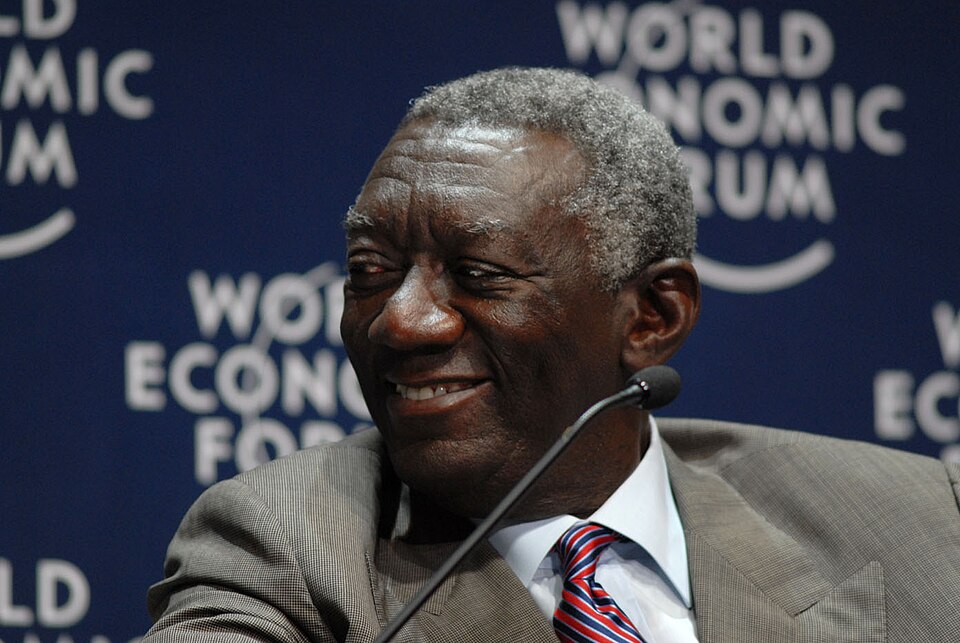
Ghana's Democratic Dawn: The 2000 Election and the Peaceful Transfer of Power
- John Kufuor
- Jerry Rawlings
- John Atta Mills
- National Democratic Congress (NDC)
- New Patriotic Party (NPP)
- Ghana Elections 2000
- Democratic Transition
- Peaceful Power Transfer
- Fourth Republic
- African Democracy
- Constitutionalism
Chapter 1
The Road to Pluralism: Ghana's Fourth Republic and the Rawlings Era (1992-2000)
The Fourth Republic began on 7 January 1993, when Flight Lieutenant Jerry John Rawlings — who had seized power twice (1979 and 1981) — was inaugurated as a constitutionally elected president. The 1992 Constitution, approved by 92.6% in a referendum on 28 April 1992, established term limits, an independent Electoral Commission, and guaranteed fundamental freedoms. Yet the transition was rocky. Rawlings won the November 1992 presidential election with 58.4% against Professor Albert Adu Boahen of the New Patriotic Party, but the opposition boycotted the subsequent parliamentary elections, alleging fraud. The NDC swept 189 of 200 seats in an essentially uncontested vote.
By 1996, the opposition returned. Rawlings won re-election with 57.2% against John Kufuor, but the NPP now held 61 seats, and the Inter-Party Advisory Committee (IPAC), established in 1994 by the Electoral Commission under Dr. Kwadwo Afari-Gyan, was building cross-party confidence. The EC compiled a new voters' register with 10,698,652 registered voters and deployed transparent ballot boxes — replacing the opaque wooden boxes that had fuelled 1992's distrust.
By 2000, Article 66 of the Constitution barred Rawlings from seeking a third term. The succession question consumed the NDC. Rawlings handpicked his vice president, Professor John Evans Atta Mills — a University of Ghana law professor and former Commissioner of the Internal Revenue Service — as the NDC candidate. Atta Mills was a mild-mannered tax specialist, the antithesis of the charismatic Rawlings, and critics questioned whether he could fill the vacuum. The stage was set for the most consequential election since independence.
About This Book
"Ghana's Democratic Dawn" meticulously chronicles the political landscape of Ghana from the promulgation of the 1992 Constitution to the watershed 2000 election. The book highlights the significance of this period as one where Ghana consolidated its democratic institutions after years of military rule and authoritarianism. It carefully examines the transition from the Provisional National Defence Council (PNDC) era under Jerry John Rawlings to the Fourth Republic, focusing on the development and evolution of multiparty politics. The book delves into the rise of key political figures such as John Agyekum Kufuor, who led the New Patriotic Party (NPP) to victory, and the strategies employed by both the NPP and the incumbent National Democratic Congress (NDC) in their quest for power. A crucial aspect of the book is its detailed analysis of the 2000 election itself. It explores the electoral processes, the roles of the Electoral Commission and its chair, Kwadwo Afari-Gyan, in ensuring a free and fair election, and the intense campaigning that characterized the period. It also examines the various factors that contributed to the NDC's defeat, including economic challenges, accusations of corruption, and the public's desire for change after almost two decades of Rawlings' leadership. The book carefully analyses regional voting patterns, highlighting the NPP's strongholds in the Ashanti Region and the NDC's support base in the Volta Region, while also noting the crucial swing votes in Greater Accra and other regions. It also considers the roles played by civil society organizations, religious bodies, and the media in shaping public opinion and promoting peaceful elections. The book also underlines the importance of the Supreme Court of Ghana in safeguarding the democratic process. The book goes further to explore the immediate aftermath of the election, including the peaceful transfer of power from Rawlings to Kufuor, a moment of profound significance for Ghana and the wider African continent. It assesses the initial challenges faced by the Kufuor administration and the impact of the transition on Ghana's political and economic development. Finally, the book reflects on the lessons learned from the 2000 election and its enduring legacy for Ghana's democracy, emphasizing the importance of strong institutions, respect for the rule of law, and a vibrant civil society in maintaining a stable and prosperous nation.
About the Author
Scholarship on Ghana's Fourth Republic, and particularly the pivotal 2000 election, builds on decades of work by Ghanaian political scientists, historians, and sociologists. Key figures such as Professor Kwame Boafo-Arthur, whose work examines democratic transitions in Africa, and Dr. Richard Asante, known for his research on Ghanaian political economy, have contributed significantly to our understanding. Furthermore, the work of researchers at the Institute of Economic Affairs (IEA) in Ghana has been instrumental in providing data and analysis on electoral processes and governance. The scholarship often draws upon primary source material like government documents, newspaper archives (such as the Daily Graphic and Ghanaian Times), and interviews with key political actors. Oral history projects, such as those conducted by the Institute of African Studies at the University of Ghana, also preserve valuable accounts of this crucial period. This book synthesizes these diverse perspectives to offer a comprehensive account of Ghana's democratic progress.
Key Themes
- Democratic Transition
- Electoral Politics
- Peaceful Transfer of Power
- Constitutionalism
- Civil Society Engagement
- Ghanaian Political History
Why This Matters
The 2000 Ghanaian election holds immense significance for understanding both Ghanaian and African heritage. It represents a critical juncture where a peaceful transfer of power solidified democratic gains, challenging the narrative of instability often associated with African nations. This event showcased the resilience of Ghanaian institutions and the commitment of its people to democratic principles.
For the diaspora and students, this story offers a powerful example of African agency and self-determination. It counters stereotypical representations and highlights the complex political processes within the continent. Understanding the nuances of Ghana's democratic journey provides valuable insights into contemporary African politics, demonstrating the importance of civic engagement, institutional development, and the rule of law. Furthermore, the story serves as an inspiration for other nations striving for democratic consolidation and peaceful transitions of power. It is a tangible example of the Sankofa principle -- learning from the past to build a better future.
Historical and Cultural Context
Ghana's 2000 election is deeply rooted in the broader history of African decolonization and the subsequent struggles for political and economic independence. It directly relates to the wave of democratization that swept across the continent in the 1990s, following decades of military rule and one-party states. Within the Sankofa Digital Heritage Library, this topic connects to other resources documenting Ghana's independence movement, the era of Kwame Nkrumah, and the various periods of military rule that preceded the Fourth Republic. Understanding these historical contexts provides a richer appreciation of the significance of the 2000 election as a triumph of democratic ideals over authoritarianism.
Sources & References
- Electoral Commission of Ghana (2001). Official Results of the 2000 Presidential Elections. Accra.
- Ayee, J.R.A. (2002). The 2000 General Elections and Presidential Run-off in Ghana. Democratization, 9(2), 148-174.
- Gyimah-Boadi, E. (2001). A Peaceful Turnover in Ghana. Journal of Democracy, 12(2), 103-117.
- The Carter Center (2001). Observing the 2000 Ghana Elections: Final Report. Atlanta, GA.
- Nugent, P. (2001). Winners, Losers and Also-Rans. African Affairs, 100(400), 405-428.
- Commonwealth Observer Group (2001). The Presidential and Parliamentary Elections in Ghana. London.