Keyboard shortcuts
- J: Next chapter
- K: Previous chapter
- T: Toggle table of contents
- Shift+S: Share book
- +: Increase font size
- -: Decrease font size
- Escape: Close modals
Chapter 1
Part 1
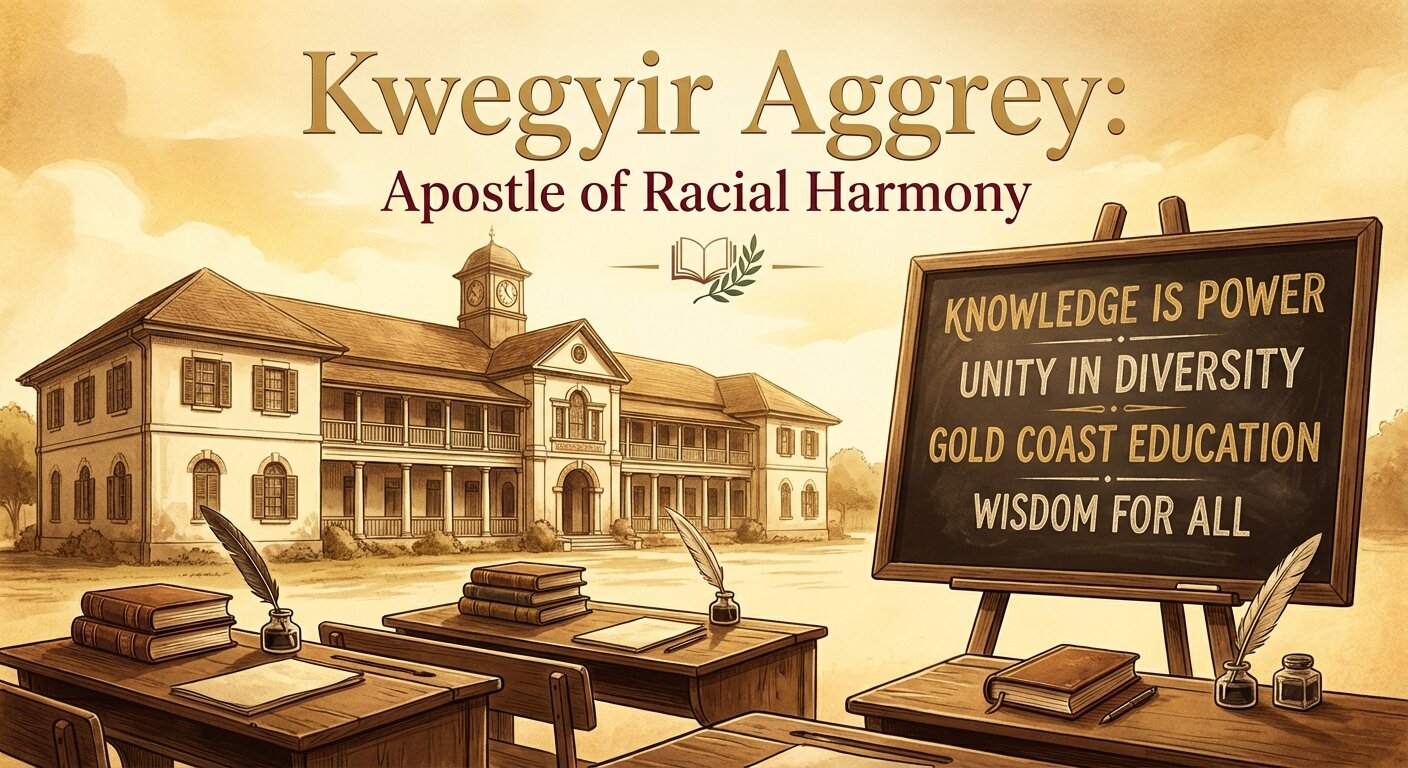
James Emman Kwegyir Aggrey, born on 18 October 1875 in the coastal town of Anomabu in the then Gold Coast, stands as a towering figure in the history of African education and a profound advocate for racial harmony. His life, a remarkable journey from a humble Fante village to international renown, left an indelible mark on education philosophy, particularly in Ghana, and inspired generations with his message of cooperation and mutual respect. Aggrey's early intellectual promise was evident at the Wesleyan School in Cape Coast, where he began his formal education. Under the tutelage of dedicated missionaries, notably Reverend A. W. Parker, Aggrey quickly distinguished himself, mastering English, Latin, and Greek. His sharp intellect and diligent nature led him to become a teacher at the very school where he had been a pupil, a common path for bright young Africans in the late 19th century Gold Coast. This early immersion in the colonial educational system, while providing access to Western knowledge, also instilled in him a critical perspective on its shortcomings in addressing indigenous needs and aspirations.
In 1898, a pivotal moment arrived when Aggrey, then just 23 years old, seized an opportunity to travel to the United States. He sailed to America with a profound desire to further his education, a journey that would profoundly shape his worldview and educational philosophy. He enrolled at Livingstone College, a historically Black institution in Salisbury, North Carolina. There, Aggrey pursued a rigorous academic curriculum, earning multiple degrees, including a Bachelor of Arts in 1902, a Master of Arts in 1912, and later, a Bachelor of Divinity in 1912. His thirst for knowledge was insatiable, leading him to study classics, theology, and the sciences. While at Livingstone, he met and married Rose Douglas, an African American woman, in 1903, establishing a family that would become his anchor throughout his international travels. Aggrey's time in America was not without its challenges; he experienced firsthand the pervasive racial segregation and discrimination of the Jim Crow South. Yet, instead of succumbing to bitterness, he used these experiences to forge a deeper conviction in the necessity of racial understanding and collaboration, observing how division hampered progress for all. He continued his studies at Columbia University in New York, embarking on a doctoral program that, tragically, he would not live to complete.
About This Book
"Kwegyir Aggrey: The Apostle of Racial Harmony" provides a crucial examination of the life and philosophy of James Emman Kwegyir Aggrey, a figure of immense significance in the history of Ghanaian education and pan-African thought. The book charts Aggrey’s trajectory from his birth in Anomabu, a vibrant coastal town with a long history of engagement with European traders and missionaries, to his transformative experiences in the United States. It meticulously details his education at Livingstone College in Salisbury, North Carolina, where he confronted the realities of racial segregation and developed his unique approach to racial reconciliation. A critical aspect of the narrative is Aggrey's involvement with the Phelps-Stokes Commissions, influential American philanthropic organizations that sought to shape education policies in Africa. The book explores Aggrey’s nuanced perspective on these initiatives, recognizing both their potential benefits and inherent limitations within the context of colonial power dynamics. The core of the book focuses on Aggrey’s role in the establishment of Achimota College (originally Prince of Wales College), a groundbreaking institution envisioned as a model for holistic education in the Gold Coast. The narrative meticulously reconstructs the debates surrounding the college's curriculum, its mission to blend Western knowledge with African traditions, and the challenges faced in creating a truly integrated learning environment. Crucially, the book analyzes Aggrey's famous "piano keys" metaphor, arguing that his vision of racial harmony was not simply about assimilation but about mutual respect and collaboration, with each "key" – representing different racial groups -- contributing to a richer and more harmonious society. Readers will gain an understanding of Aggrey's complex relationship with colonial authorities, his advocacy for African self-determination through education, and the enduring impact of his vision on Ghana’s educational landscape. The work also highlights criticisms leveled at Aggrey's approach, acknowledging the complexities of navigating racial politics within a colonial framework.
About the Author
The scholarship on James Emman Kwegyir Aggrey stands on the shoulders of numerous historians, biographers, and educators who have dedicated themselves to preserving and interpreting his legacy. Early biographies, often produced shortly after his death in 1927, tended to focus on his personal charisma and spiritual qualities, casting him as a near-saintly figure. Later works have adopted a more critical lens, examining Aggrey's role within the broader context of colonial education and pan-Africanism. Contemporary scholars draw upon a wealth of primary sources, including Aggrey’s personal letters, speeches, and writings, as well as archival materials from Achimota College, the Phelps-Stokes Fund, and various missionary societies. These sources are supplemented by oral histories and interviews with individuals who knew Aggrey or were influenced by his ideas. This work also reflects ongoing debates about the nature of "racial harmony" in post-colonial societies and the legacies of colonial education in shaping contemporary African identities.
Key Themes
- Racial cooperation
- Holistic education
- Colonial education
- Pan-Africanism
- Cultural identity
- Achimota College
Why This Matters
The story of Kwegyir Aggrey holds profound significance for understanding Ghanaian and African heritage. His life and work embody the complex negotiations between Western influence and African self-determination during the colonial era. Aggrey's vision of education as a tool for empowerment and cultural preservation remains deeply relevant today, particularly in the face of ongoing globalization and cultural homogenization. His emphasis on holistic education, encompassing both academic knowledge and character development, provides a valuable model for contemporary educational systems.
For the diaspora, Aggrey represents a bridge between Africa and the Americas, a testament to the intellectual and cultural exchange that has shaped the African diaspora's identity. His story underscores the importance of engaging with one’s ancestral roots while embracing the opportunities and challenges of living in diverse societies. Students, in particular, can draw inspiration from Aggrey's commitment to social justice and his unwavering belief in the power of education to transform individuals and communities. Understanding Aggrey's complexities -- his successes and compromises -- offers valuable insights into navigating the ongoing struggles for racial equality and social justice both in Africa and globally.
Historical and Cultural Context
Aggrey’s work connects to broader themes within African history, particularly the history of education during the colonial period. His emphasis on blending Western knowledge with African traditions mirrors similar efforts in other parts of the continent, such as the establishment of independent schools in Kenya and the development of African-centered curricula in Nigeria. Within the Sankofa Library, Aggrey's story complements narratives of other pan-African thinkers and activists who sought to challenge colonial power structures and promote African unity. Understanding Aggrey alongside figures like Kwame Nkrumah and Nnamdi Azikiwe reveals the diverse approaches to achieving African independence and self-determination. His focus on education can also be compared with the work of other educators, such as Charlotte Maxeke in South Africa, illustrating a continent-wide movement to empower Africans through knowledge and skill development.
Sources & References
- Akyeampong, E. (2006). Themes in West Africa History. James Currey.
'/%3E%3Crect width='900' height='1200' fill='url(%23p)' opacity='.7'/%3E%3Ctext x='450' y='560' text-anchor='middle' font-size='140' font-family='serif'%3E%E2%9C%8A%3C/text%3E%3Ctext x='450' y='680' text-anchor='middle' fill='%23fff3c4' font-size='54' font-family='Georgia,serif' font-weight='700'%3ESankofa Library%3C/text%3E%3Ctext x='450' y='745' text-anchor='middle' fill='%23fff3c4' fill-opacity='.8' font-size='30' font-family='Arial,sans-serif'%3ECover under review%3C/text%3E%3C/svg%3E)