Keyboard shortcuts
- J: Next chapter
- K: Previous chapter
- T: Toggle table of contents
- Shift+S: Share book
- +: Increase font size
- -: Decrease font size
- Escape: Close modals
Chapter 1
The Coup, the Crisis, and the Call to Feed Yourself (1972)
On 13 January 1972, Colonel Ignatius Kutu Acheampong — born 23 September 1931 in Kumasi, a former student at the Central University College in Winneba, and a graduate of the U.S. Army's Command and General Staff College at Fort Leavenworth, Kansas — overthrew Prime Minister Kofi Abrefa Busia's civilian government in a bloodless military coup while Busia was in London receiving medical treatment. The National Redemption Council (NRC) seized power with a single tank column rolling into Accra at dawn.
Busia had inherited an economy crippled by Nkrumah-era debts and declining cocoa prices. His December 1971 devaluation of the cedi by 44 percent under International Monetary Fund pressure provoked fury among the military, whose salaries and import purchasing power were slashed overnight. Acheampong's first act was dramatic: he repudiated $94 million in commercial debt, renegotiated state obligations, and declared that Ghana would no longer be "a beggar nation." The Apollo 568 devaluation was reversed.
In February 1972, barely a month after seizing power, Acheampong launched Operation Feed Yourself (OFY), Ghana's most ambitious agricultural programme since independence. The ideological basis was self-reliance — a conscious rejection of the colonial agricultural structure that had oriented Ghana's farming toward export crops (cocoa, palm oil, rubber) for European markets while the country imported rice, wheat, and sugar. As Stefan Meier documented in his 2012 University of Basel thesis, OFY aimed to "correct the image of a beggar nation" and transform Ghana from a food importer into a self-sufficient producer.
The programme's Five Year Plan set a target of 6 percent annual growth in agricultural output, more than double the 2.6 percent achieved under Busia between 1969-1972. It projected an increase of 800,000 new farmers by 1990 and envisioned agriculture's GDP contribution rising from 1,800 million cedis to 2,600 million cedis. Colonel Frank George Bernasko, the former Central Regional Commissioner, was appointed Commissioner for Agriculture to lead the programme.
About This Book
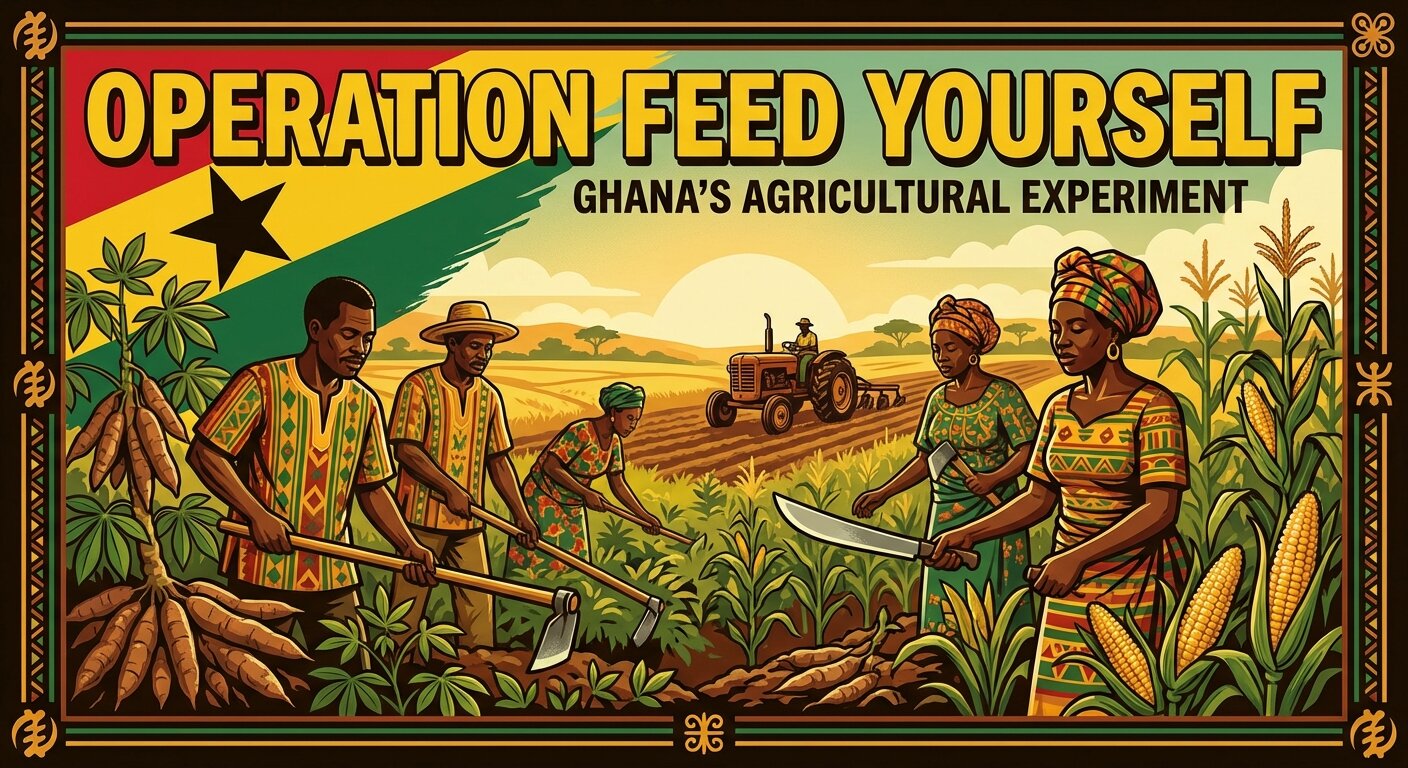
"Operation Feed Yourself: Ghana's Agricultural Experiment" delves into one of the most significant, albeit ultimately flawed, initiatives in post-colonial Ghanaian history. Launched in 1972 by General Ignatius Kutu Acheampong's National Redemption Council (NRC), Operation Feed Yourself (OFY) aimed to achieve national self-sufficiency in food production. The book meticulously traces the genesis of OFY, born from a potent mix of patriotic fervor and economic necessity following Kwame Nkrumah's overthrow and subsequent economic instability. The Acheampong regime, facing foreign exchange constraints and rising food import bills, presented OFY as a means of reclaiming Ghana's agricultural prowess and reducing dependence on foreign powers. Initially, OFY enjoyed considerable success. The NRC implemented policies such as subsidized fertilizers, guaranteed prices for farmers, and mobilization of students and civil servants to assist with agricultural labor. The book highlights how these policies led to a notable increase in the production of key staples like rice, maize, and cassava. The campaign tapped into a deep well of national pride, encouraging Ghanaians to embrace farming as a patriotic duty. Testimonies and archival records reveal a period of enthusiastic participation across various segments of society. However, the book doesn't shy away from examining the systemic challenges that undermined OFY's long-term viability. It scrutinizes the economic mismanagement that plagued the Acheampong regime, including rampant corruption, unsustainable borrowing, and the overvaluation of the cedi. These factors created distortions in the agricultural sector, making it difficult for farmers to access inputs and sell their produce at fair prices. Furthermore, the book explores the impact of environmental factors, such as droughts and pests, which periodically devastated crops. The narrative culminates in the eventual decline and failure of OFY, highlighting the complex interplay of political, economic, and environmental forces that shaped its trajectory. Readers will gain an understanding of the complexities of agricultural development in post-colonial Africa and the challenges of achieving food security in the face of internal and external pressures.
About the Author
The scholarship surrounding Operation Feed Yourself is interwoven with the broader study of post-independence development initiatives in Ghana and Africa. Historians like Richard Jeffries have provided invaluable insights into the political economy of the Acheampong regime, highlighting the factors that contributed to both its initial popularity and its ultimate downfall. Scholars such as Kodwo Ewusi have analyzed the economic policies of the period, assessing their impact on various sectors of the Ghanaian economy, including agriculture. Furthermore, the work of agricultural economists like Nii Kwate Owoo has examined the specific challenges faced by Ghanaian farmers in the post-colonial era. These scholarly traditions, often drawing upon archival research, oral histories, and statistical analysis, provide a rich context for understanding the complexities of Operation Feed Yourself and its lasting legacy. Contemporary scholars continue to re-evaluate these historical narratives, often bringing new perspectives on issues of sustainability, social justice, and the role of external actors in shaping Ghana's agricultural development trajectory.
Key Themes
- Agricultural policy
- Economic development
- Post-colonial Ghana
- Nationalism
- Food security
Why This Matters
Understanding Operation Feed Yourself is crucial for grasping the challenges and opportunities facing Ghana and Africa in the 21st century. It serves as a cautionary tale about the complexities of agricultural self-sufficiency and the need for sustainable, equitable development strategies. The story of OFY resonates powerfully with the African diaspora, offering insights into the aspirations and struggles of the post-colonial generation. It highlights the importance of economic independence and the pursuit of food security as fundamental pillars of national sovereignty.
For students, especially, OFY provides a valuable case study in development economics, political science, and African history. It underscores the need for holistic approaches to development, addressing not only production but also issues of distribution, access, and environmental sustainability. The legacy of OFY continues to shape contemporary debates about agricultural policy in Ghana, as policymakers grapple with the challenges of ensuring food security in the face of climate change, globalization, and rapid urbanization. Its story serves as a reminder of the importance of learning from past mistakes and charting a more sustainable path towards a food-secure future.
Historical and Cultural Context
Operation Feed Yourself can be understood as part of a broader wave of post-colonial development initiatives across Africa, many of which aimed to achieve economic self-reliance and break free from the legacy of colonial dependency. Similar campaigns, often driven by nationalist fervor and a desire to assert control over national resources, were launched in countries like Tanzania (Ujamaa) and Zambia (Mulungushi Reforms). Within the Sankofa Library, OFY can be contextualized alongside other narratives of post-colonial nation-building, highlighting both the shared aspirations and the diverse challenges faced by African nations in their pursuit of economic and political autonomy. Its story is also relevant to understanding contemporary debates about land reform, agricultural investment, and the role of technology in transforming African agriculture.
Sources & References
- Chazan, Naomi (1983). An Anatomy of Ghanaian Politics: One Party Democracy and Other Misadventures. Westview Press.
- Killick, Tony (1978). Development Economics in Action: A Study of Economic Policies in Ghana. Heinemann Educational Books.
- Botchway, Francis N. (1972). Political Development and Social Change in Ghana: A Study of the National Redemption Council. Ghana Publishing Corporation.
'/%3E%3Crect width='900' height='1200' fill='url(%23p)' opacity='.7'/%3E%3Ctext x='450' y='560' text-anchor='middle' font-size='140' font-family='serif'%3E%E2%9C%8A%3C/text%3E%3Ctext x='450' y='680' text-anchor='middle' fill='%23fff3c4' font-size='54' font-family='Georgia,serif' font-weight='700'%3ESankofa Library%3C/text%3E%3Ctext x='450' y='745' text-anchor='middle' fill='%23fff3c4' fill-opacity='.8' font-size='30' font-family='Arial,sans-serif'%3ECover under review%3C/text%3E%3C/svg%3E)