Keyboard shortcuts
- J: Next chapter
- K: Previous chapter
- T: Toggle table of contents
- Shift+S: Share book
- +: Increase font size
- -: Decrease font size
- Escape: Close modals
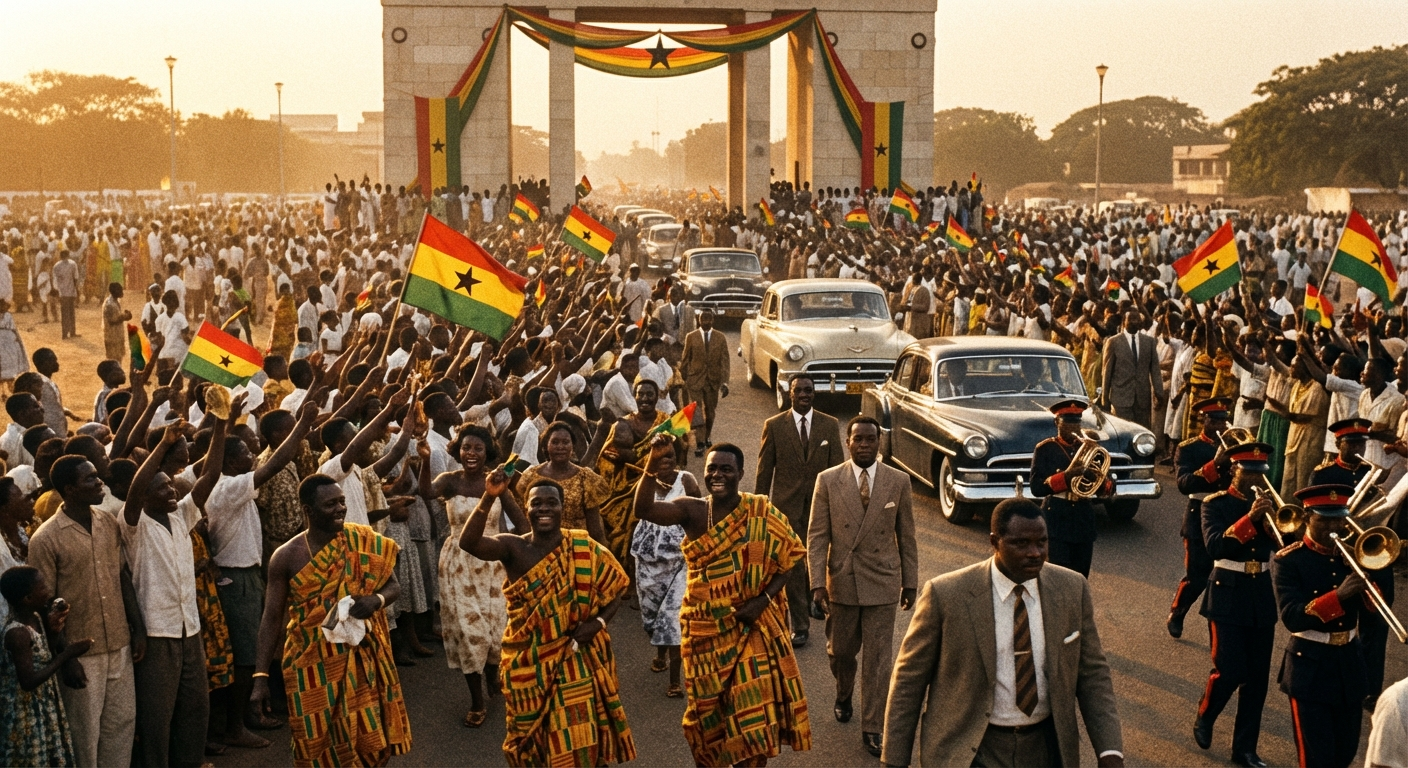
The Midnight Echo: Kwame Nkrumah's Declaration and the Genesis of Ghana
- Kwame Nkrumah
- Ghana Independence
- Midnight Speech
- Gold Coast
- Pan-Africanism
- Accra
- Convention People's Party (CPP)
- March 6, 1957
- Decolonization
- African Nationalism
Chapter 1
The Crucible of Colonialism: Seeds of Resistance in the Gold Coast
Long before Kwame Nkrumah stood at the Old Polo Grounds, the Gold Coast had been simmering with resistance. The British had formally declared the territory a Crown Colony in 1874, but the people of the Gold Coast never accepted subjugation quietly. The Fante Confederacy of 1868-1873 represented one of the earliest attempts at self-governance, a sophisticated experiment in constitutional rule that the British dismantled precisely because it threatened their authority.
By the early twentieth century, a new generation of educated Africans began to challenge colonial rule through institutions and ideas. Joseph Ephraim Casely Hayford, a lawyer and journalist from Cape Coast, founded the National Congress of British West Africa in 1920. "The notion that the African is incapable of self-government is as old as it is false," Casely Hayford wrote in his landmark 1911 book Ethiopia Unbound. The Congress sent a delegation to London demanding elected representation, shocking colonial authorities who had assumed Africans had no interest in governance.
The economic exploitation was relentless. The colonial government controlled the export of cocoa, the colony"s primary cash crop, setting prices that enriched European trading firms while impoverishing Gold Coast farmers. In 1937-38, cocoa farmers organized a remarkable boycott, refusing to sell their beans for six months. Chief Nana Sir Ofori Atta I of Akyem Abuakwa and other traditional leaders supported the holdout. The farmers won meaningful concessions, demonstrating that organized resistance could force the hand of empire.
World War II proved to be the final catalyst. Over 65,000 Gold Coast men served in the British armed forces, fighting in Burma, East Africa, and the Middle East. They returned home expecting the freedoms they had fought to defend, only to find the same colonial system intact. Sergeant Adjetey, Corporal Attipoe, and Private Odartey Lamptey, three of these ex-servicemen, were shot dead by colonial police on February 28, 1948, while marching peacefully to present a petition to the Governor at Christiansborg Castle. Their deaths ignited the 1948 Accra Riots, and the colonial order in the Gold Coast would never recover.
About This Book
"The Midnight Echo: Kwame Nkrumah's Declaration and the Genesis of Ghana" meticulously examines the pivotal period leading up to and immediately following Ghana's independence. It delves into the complex tapestry of social, political, and economic factors that fueled the nationalist movement, tracing its roots from the formation of the United Gold Coast Convention (UGCC) in 1947 to the dramatic moment of liberation on March 6, 1957. The book meticulously analyzes Nkrumah's strategic leadership, highlighting his ability to galvanize diverse groups -- including urban workers, farmers, intellectuals, and traditional rulers -- under a unified banner of self-determination. It details the evolution of Nkrumah's political philosophy, from his early advocacy for gradual constitutional reform to his embrace of "Positive Action," a strategy of non-violent resistance and civil disobedience that directly challenged British colonial authority. The narrative explores the key events that shaped the independence struggle, including the 1948 Accra riots, the subsequent imprisonment of the "Big Six," and the formation of the Convention People's Party (CPP) in 1949. Furthermore, the book provides an in-depth examination of the drafting and implications of the 1957 Constitution and examines the establishment of Ghana's independent institutions. It analyzes Nkrumah's vision for a Pan-African future, exploring how Ghana's independence served as a catalyst for liberation movements across the African continent. Readers will gain an understanding of the immense challenges faced by the newly independent nation, including navigating Cold War politics, building a national economy, and consolidating its democracy. Ultimately, the book elucidates how the declaration of independence at the Old Polo Grounds was not merely a symbolic gesture but a watershed moment that irrevocably altered the course of Ghanaian and African history.
About the Author
Ghana's independence struggle and its aftermath have been chronicled by a wide array of scholars, both Ghanaian and international. Early works by Kwame Nkrumah himself, such as "Ghana: The Autobiography of Kwame Nkrumah" and "Africa Must Unite," offer invaluable insights into his perspective and political vision. Dennis Austin's "Politics in Ghana, 1946-1960" provides a detailed analysis of the political dynamics of the period. More recent scholarship, such as Richard Rathbone's work on Nkrumah and David Birmingham’s "The Decolonization of Africa," offer revised interpretations, incorporating social and economic perspectives. The historical work of F. Agbodeka and Adu Boahen have shaped the understanding of the pre-independence era. Contemporary Ghanaian historians continue to build upon this legacy, utilizing oral histories and archival research to provide fresh perspectives on this formative period.
Key Themes
- Nationalism
- Pan-Africanism
- Decolonization
- Kwame Nkrumah's Leadership
- Positive Action
- Constitutionalism
Why This Matters
Ghana's independence holds immense significance for understanding Ghanaian and African heritage because it represents a defining moment in the struggle against colonialism and a powerful assertion of African self-determination. It signaled the end of an era and ignited the flame of liberation across the continent, inspiring numerous other nations to pursue their own independence. Understanding this history is crucial for appreciating the complexities of post-colonial Africa, the challenges of nation-building, and the enduring legacy of Pan-Africanism.
For the diaspora, particularly those of African descent, Ghana's story is a source of pride and inspiration. It demonstrates the agency and resilience of Africans in shaping their own destiny. For students, it offers valuable insights into the dynamics of colonialism, resistance, and the emergence of modern African states. Studying this period fosters a deeper understanding of contemporary issues facing the African continent and the diaspora, as well as the ongoing pursuit of social justice, economic development, and cultural preservation.
Historical and Cultural Context
The declaration of Ghana's independence must be understood within the broader context of the global decolonization movement following World War II. The Atlantic Charter (1941), for instance, laid out principles of self-determination that resonated deeply with colonized peoples. Ghana’s story mirrors and interacts with other independence movements across Africa – in Nigeria, Kenya, and Algeria. Within the Sankofa Digital Heritage Library, this narrative connects with materials documenting pre-colonial African kingdoms, the transatlantic slave trade, and the rise of Pan-African thought. Ghana's journey also intersects with the Civil Rights Movement in the United States, highlighting the shared struggles against racial discrimination and the pursuit of equality.
Sources & References
- Nkrumah, Kwame. Independence Speech, March 6, 1957, Old Polo Grounds, Accra.
- King, Martin Luther Jr. "The Birth of a New Nation" sermon, Dexter Avenue Baptist Church, April 7, 1957.
- The Guardian. "From the archive, 6 March 1957: Hoisting the flag of Ghana." March 6, 1957.
- Hansard. "Ghana Independence Celebrations." House of Lords, February 21, 1957.
- Martin Luther King Jr. Research and Education Institute, Stanford University. "Ghana Trip."
- Nkrumah, Kwame. Ghana: The Autobiography of Kwame Nkrumah. Thomas Nelson & Sons, 1957.
- Rooney, David. Kwame Nkrumah: Vision and Tragedy. Sub-Saharan Publishers, 2007.