Keyboard shortcuts
- J: Next chapter
- K: Previous chapter
- T: Toggle table of contents
- Shift+S: Share book
- +: Increase font size
- -: Decrease font size
- Escape: Close modals
From Colony to Constitution: Ghana's Four Republics and the Long Road to Democratic Governance
- Constitutional History
- Fourth Republic
- 1992 Constitution
- Nkrumah
- Rawlings
- Democracy
- Military Coups
- PNDC
- Elections
- Ghana Politics
Chapter 1
Part 1
On April 28, 1992, Ghanaians went to the polls in a referendum to approve a new constitution. The vote was 92.6% in favour. It was the fourth time in thirty-five years that the country had attempted to establish a durable framework for democratic governance. The previous three constitutions had lasted, respectively, three years, three years, and two years before being swept away by military coups. The generals, colonels, and flight lieutenants who seized power always promised to return the country to civilian rule, and they always eventually did, only for the cycle to repeat. The 1992 Constitution, inaugurating Ghana's Fourth Republic on January 7, 1993, broke this pattern. It has now survived longer than all its predecessors combined, and Ghana has conducted eight consecutive peaceful elections under its provisions. Understanding how Ghana arrived at this constitutional settlement requires tracing the full arc of its constitutional experiments since independence.
The 1957 Independence Constitution was, in essence, the Burns Constitution of 1950 and the Nkrumah Constitution of 1954 refined and extended to cover a sovereign state. It established a parliamentary system modelled on Westminster: a ceremonial head of state (initially the Queen, represented by a Governor-General), a Prime Minister who commanded a majority in the National Assembly, an independent judiciary, and a bill of rights. The architect of this constitution was the Coussey Committee, chaired by Justice Henley Coussey, which had been appointed in 1949 following the Accra riots of 1948. Its 40 members included J.B. Danquah, who pushed for stronger protections for regional autonomy and traditional authority.
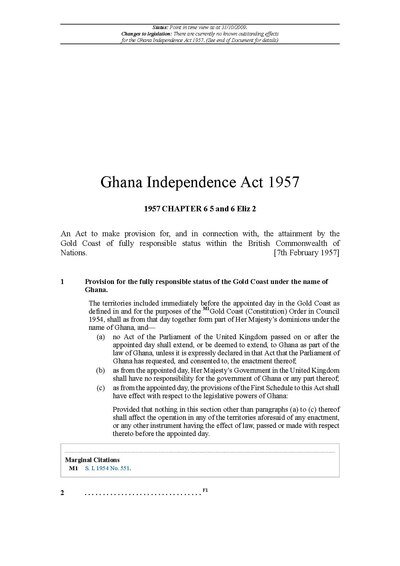
But the 1957 Constitution contained the seeds of its own destruction. It gave the National Assembly the power to amend the constitution by a simple two-thirds majority, without a referendum. Nkrumah used this provision with devastating efficiency. The Constitution (Repeal of Restrictions) Act of 1958 removed the regional assemblies that had been created to protect Ashanti and Northern interests. The Preventive Detention Act of the same year, which allowed imprisonment without trial for up to five years (later extended to ten), effectively gutted the bill of rights. In 1960, Nkrumah held a plebiscite that simultaneously approved a new republican constitution and elected him as executive president. The 1960 Republican Constitution concentrated power in the presidency to an extraordinary degree: the President could legislate by decree, dismiss judges, and override any act of Parliament. By 1964, a constitutional amendment had made Ghana a one-party state, with the Convention People's Party as the sole legal political organisation. The 1957 Constitution had lasted barely three years in its original form.
About This Book
"From Colony to Constitution: Ghana's Four Republics and the Long Road to Democratic Governance" meticulously chronicles Ghana's tumultuous journey from British colony to a (relatively) stable constitutional democracy. The book dissects each of Ghana's four republics, analyzing the political, economic, and social factors that led to their establishment and subsequent collapse. The narrative begins with the optimism of independence in 1957 and the adoption of a Westminster-style constitution, exploring Kwame Nkrumah's leadership and his vision of a unified, socialist Ghana. However, the book does not shy away from examining the increasing authoritarianism that characterized Nkrumah's regime, ultimately culminating in the 1966 coup. The subsequent Second Republic, under Prime Minister Kofi Abrefa Busia, represented a brief experiment in liberal democracy, attempting to steer Ghana away from Nkrumah's socialist policies. This period is analyzed in detail, highlighting the challenges faced by Busia's government, including economic instability and accusations of ethnic favoritism -- factors that contributed to its overthrow in 1972. The book then delves into the various military regimes that dominated Ghanaian politics for much of the 1970s and 1980s. The Supreme Military Council (SMC) era under Generals Acheampong and Akuffo, marked by economic mismanagement and corruption, is critically examined. The short-lived Armed Forces Revolutionary Council (AFRC) under Jerry Rawlings, with its radical "housecleaning" exercise, receives due attention. The Provisional National Defence Council (PNDC), also led by Rawlings, which initially pursued revolutionary socialist policies before adopting structural adjustment programs, forms a significant portion of the narrative. Finally, the book culminates with the establishment of the Fourth Republic in 1992, analyzing the transition from military rule to constitutional governance. The book explores the key features of the 1992 Constitution, its strengths and weaknesses, and the challenges that Ghana continues to face in consolidating its democracy. This is a story of leaders, constitutions, and political experiments that have determined Ghana's path, one which readers will come to appreciate by the end.
About the Author
The study of Ghana's constitutional history is a rich and varied field, drawing upon the work of legal scholars, political scientists, historians, and sociologists. Early works on the subject often focused on the colonial legal framework and the transition to independence, such as Dennis Austin's "Politics in Ghana, 1946-1960." More recent scholarship has focused on specific periods, such as the Nkrumah era, or themes such as the role of the judiciary. J.B. Danquah's writings, while partisan, provide valuable insight into the intellectual debates surrounding independence. Scholars like Richard Crook and Joseph Ayee have contributed significantly to our understanding of governance and corruption in Ghana. These and numerous other scholars' work forms the basis of this particular book. This book builds upon this tradition of rigorous scholarship.
Key Themes
- Constitutionalism
- Military Intervention
- Economic Development
- Political Instability
- Democratic Transition
- Leadership
- Corruption
Why This Matters
Ghana's constitutional journey is a microcosm of the challenges faced by many post-colonial African states. It highlights the complex interplay of political ideologies, economic pressures, and social forces that shape the trajectory of nation-building. Understanding this history is crucial for grasping the present-day realities of Ghanaian politics and society.
For the diaspora, this story offers a powerful connection to their ancestral homeland, providing insights into the struggles and triumphs that have shaped Ghana. For students of African history and political science, Ghana's experience offers valuable case studies in democratization, constitutional design, and the challenges of good governance. Examining Ghana's past helps to inform present-day efforts to strengthen democratic institutions and promote sustainable development, and allows us to learn from history.
Historical and Cultural Context
Ghana's constitutional evolution must be viewed within the broader context of Pan-Africanism and the struggle for liberation across the African continent. Nkrumah's vision of a united Africa significantly influenced the early years of independence. The subsequent periods of political instability and military rule mirrored similar trends in other African nations. This narrative also connects to the Sankofa Library's collection of materials on colonial resistance, post-colonial development, and the search for self-determination, further enriching our understanding of Ghana's place in African history.
Sources & References
- Gyimah-Boadi, E. 'Ghana's Fourth Republic: Championing the African Democratic Renaissance?' Ghana Center for Democratic Development, 2009.
- Oquaye, Mike. Politics in Ghana, 1972-1979. Tornado Publications, 1980.
- Prempeh, H. Kwasi. 'Marbury in Africa: Judicial Review and the Challenge of Constitutionalism in Contemporary Africa.' Tulane Law Review 80 (2006).
- Austin, Dennis. Politics in Ghana, 1946-1960. Oxford University Press, 1964.
- Ninsin, Kwame. Ghana's Political Transition 1990-1993. Freedom Publications, 1998.
- Constitution of the Republic of Ghana, 1992.
- Boahen, Adu. The Ghanaian Sphinx: Reflections on the Contemporary History of Ghana. Sankofa Educational Publishers, 1989.
- Nugent, Paul. Big Men, Small Boys and Politics in Ghana. Asempa Publishers, 1996.