
Keyboard shortcuts
- J: Next chapter
- K: Previous chapter
- T: Toggle table of contents
- Shift+S: Share book
- +: Increase font size
- -: Decrease font size
- Escape: Close modals
Chapter 1
Part 1
The Ashanti Kingdom is one of the most storied and heavily studied traditional states in African history. For centuries, the occupant of the Golden Stool, the Asantehene, wielded absolute political, military, and spiritual power over a vast empire that stretched across the forests of central Ghana. The British Empire fought five separate wars over seventy years before finally managing to subdue the kingdom and exile its king, Prempeh I, to the Seychelles in 1896. Yet, unlike many traditional monarchies that faded into ceremonial irrelevance after colonialism and the rise of the modern nation state, the Ashanti monarchy survived. More remarkably, it adapted.
At the center of this modern adaptation is Otumfuo Osei Tutu II, who ascended to the Golden Stool in 1999. His reign represents a fascinating case study in the exercise of traditional authority within the constitutional framework of a modern democratic republic. He is not a head of state, he commands no standing army, and he holds no formal executive power under the 1992 Constitution of Ghana. Yet, he is arguably the most powerful non-elected figure in the country. This narrative explores how Otumfuo Osei Tutu II redefined the role of the Asantehene for the 21st century. It examines his groundbreaking initiatives in education, his crucial role as a mediator in national and regional conflicts, and the delicate balance he maintains between preserving ancient spiritual traditions and driving modern economic development.
The man who would become the 16th Asantehene was born Nana Barima Kwaku Duah on May 6, 1950, in Kumasi. His lineage placed him squarely at the center of Ashanti royalty. He is the direct descendant of the founder of the Ashanti Empire, Osei Tutu I, and his mother, Nana Afia Kobi Serwaa Ampem II, served as the Asantehemaa (Queen Mother) for thirty-nine years. In the matrilineal system of the Akan people, the Queen Mother holds the exclusive customary right to nominate the candidate for the Golden Stool when it becomes vacant.
Despite his royal pedigree, his early life was marked by a deliberate exposure to the wider world. He was educated at the Sefwi Wiawso Secondary School and later at the Osei Kyeretwie Secondary School in Kumasi. To broaden his horizons and prepare him for the complexities of modern administration, his family sent him to the United Kingdom for higher education. He studied accountancy at the Kilburn Polytechnic in London and later pursued a degree in Human Resource Management and Public Administration at the University of North London.
Following his studies, he did not immediately return to the royal court in Kumasi. Instead, he spent years working in the private sector in the United Kingdom and Canada, gaining practical experience in corporate governance, finance, and international business. He worked as a senior consultant at the Mutual of Omaha Insurance Company in Toronto and later returned to London to work in various managerial capacities. In 1989, he finally returned to Ghana, establishing his own successful transport and mining equipment supply company, Transpomech International.
This background in international business and corporate management was unconventional for a traditional ruler, but it proved to be precisely the preparation required for the challenges of the modern era. When the previous Asantehene, Otumfuo Opoku Ware II, passed away in 1999, the Queen Mother nominated Nana Barima Kwaku Duah to succeed him. The nomination was unanimously accepted by the Kumasi Traditional Council, and he was enstooled as Otumfuo Osei Tutu II on April 26, 1999. He took the name of the empire's founder, signaling a commitment to both continuity and bold, foundational leadership.
About This Book
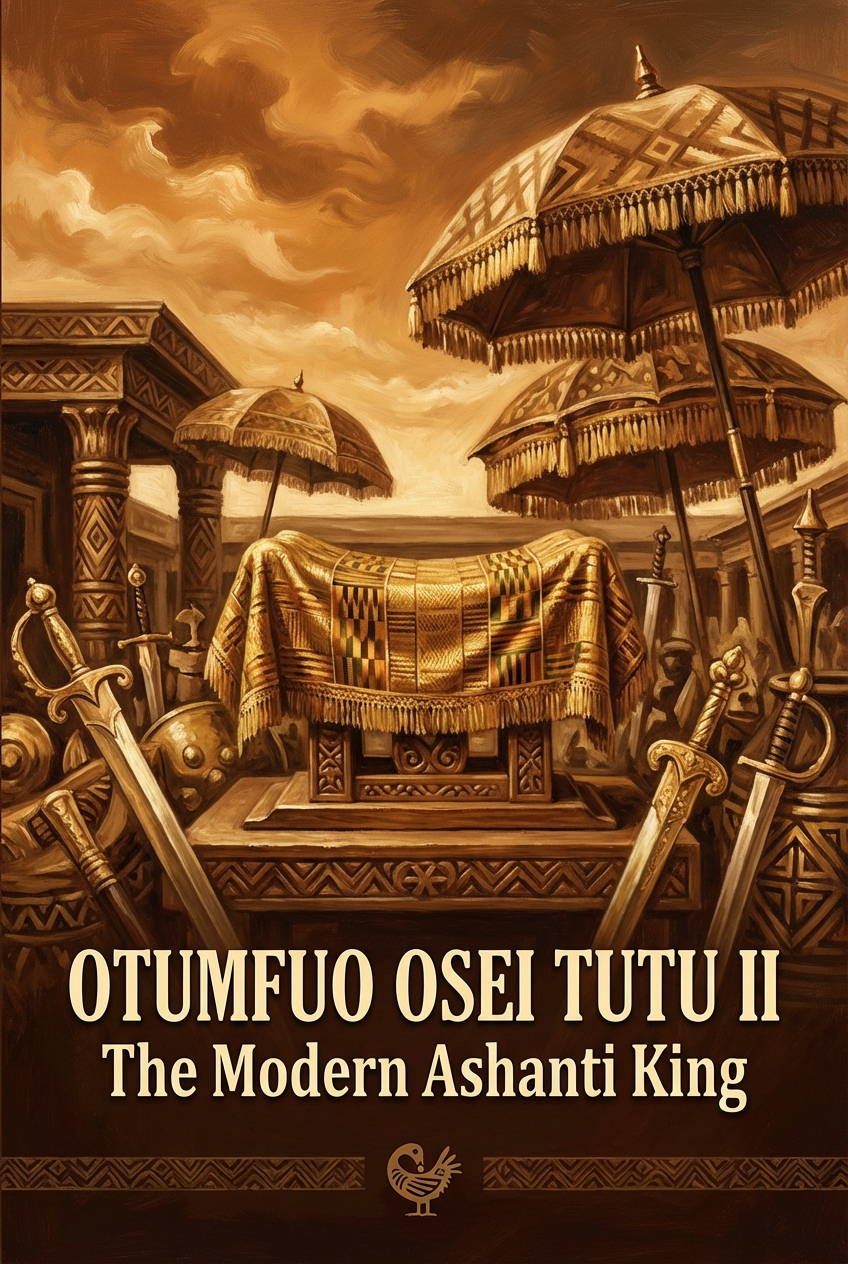
"Otumfuo Osei Tutu II: The Modern Ashanti King" offers a comprehensive examination of the reign of the current Asantehene, focusing on his innovative approaches to traditional leadership in a rapidly changing Ghana. The book delves into Otumfuo Osei Tutu II's multifaceted role, revealing how he has navigated the complexities of chieftaincy within a democratic framework. A central theme is the Otumfuo Education Fund, a groundbreaking initiative established in 1999. The book details its impact, highlighting its role in increasing access to education for underprivileged students across Ghana, not just within the Ashanti Region. It analyzes the fund's structure, its funding mechanisms, and its challenges, including ensuring its long-term sustainability and equitable distribution. Beyond education, the book explores Otumfuo's skillful intervention in land disputes. In the Ashanti region, land tenure is deeply intertwined with tradition, lineage, and power. The book examines specific case studies of conflicts that Otumfuo has mediated, demonstrating his ability to balance customary law with contemporary legal frameworks. It shows how he has averted potentially violent confrontations and fostered peaceful resolutions, contributing to regional stability and economic development. His method often involves bringing together elders, legal experts, and community representatives, ensuring fair and transparent processes. Furthermore, the book examines Otumfuo's significant role as a shadow diplomat. It provides examples of his interventions in national political crises, particularly during periods of electoral tension. It discusses his ability to convene political leaders from different parties, facilitate dialogue, and promote national unity. The book argues that his moral authority and respect across the political spectrum enable him to play a crucial role in maintaining peace and stability in Ghana. It acknowledges criticisms of his interventions, analyzing the delicate balance between traditional authority and democratic governance. Ultimately, the book argues that Otumfuo Osei Tutu II exemplifies a modern Ashanti King, adept at preserving cultural heritage while embracing progress and contributing to Ghana's development. It provides a nuanced portrait of a leader who is both a symbol of tradition and a catalyst for change.
About the Author
Scholarship on the Ashanti monarchy is a rich and vibrant field, built upon the foundations laid by early ethnographers like R.S. Rattray, whose works documented Ashanti customs and beliefs in the colonial era. Later scholars such as Ivor Wilks, author of "Asante in the Nineteenth Century," provided detailed historical analyses of the kingdom's political and economic structures. More recently, scholars like T.C. McCaskie have explored the cultural dimensions of Ashanti identity and power. This book builds upon this tradition of scholarship, drawing upon archival sources, oral histories, and contemporary observations to offer a nuanced portrait of Otumfuo Osei Tutu II. It engages with existing literature on Ashanti chieftaincy, while also offering new insights into the challenges and opportunities facing traditional leaders in the 21st century. This study benefits greatly from the increasing access to local language sources, which gives greater depth to analysis.
Key Themes
- Modern Chieftaincy
- Education & Development
- Conflict Resolution
- Traditional Governance
- Cultural Preservation
- Political Mediation
Why This Matters
The study of Otumfuo Osei Tutu II’s reign is vital for understanding contemporary Ghanaian and African heritage. It highlights the enduring relevance of traditional institutions in modern nation-states. In an era of globalization and rapid social change, the book demonstrates how traditional leaders can adapt and innovate while upholding cultural values. It is especially relevant for the diaspora, as it offers a window into the complexities of Ghanaian society and the ongoing negotiation between tradition and modernity. For students, this book provides a valuable case study of leadership, governance, and the role of culture in development. Understanding the Ashanti monarchy's influence on contemporary Ghana offers critical insight into a unique system of power sharing. The book underscores the importance of studying African institutions on their own terms, rather than through a purely Western lens.
Historical and Cultural Context
Understanding the role of Otumfuo Osei Tutu II requires placing it within the broader context of African chieftaincy. Across the continent, traditional leaders continue to play significant roles in governance, conflict resolution, and cultural preservation. The Ashanti monarchy, with its rich history and complex political system, offers a particularly compelling example. Within the Sankofa Library, this book connects to themes of pre-colonial statehood, colonial resistance, and post-colonial nation-building. It also complements materials on other significant African kingdoms and their evolving roles in the modern era.


'/%3E%3Crect width='900' height='1200' fill='url(%23p)' opacity='.7'/%3E%3Ctext x='450' y='560' text-anchor='middle' font-size='140' font-family='serif'%3E%E2%AD%90%3C/text%3E%3Ctext x='450' y='680' text-anchor='middle' fill='%23fff3c4' font-size='54' font-family='Georgia,serif' font-weight='700'%3ESankofa Library%3C/text%3E%3Ctext x='450' y='745' text-anchor='middle' fill='%23fff3c4' fill-opacity='.8' font-size='30' font-family='Arial,sans-serif'%3ECover under review%3C/text%3E%3C/svg%3E)