
Keyboard shortcuts
- J: Next chapter
- K: Previous chapter
- T: Toggle table of contents
- Shift+S: Share book
- +: Increase font size
- -: Decrease font size
- Escape: Close modals
Chapter 1
Origins and Religious Foundations: The Ewe Practice of Ritual Atonement
Ritual servitude, known as trokosi in Ghana, is a practice among the Ewe people in the Volta Region where traditional religious shrines take human beings—usually young virgin girls—in payment for services or in religious atonement for alleged misdeeds of a family member. The word trokosi comes from the Ewe-Gbe words "tro" (deity or fetish) and "kosi" (female slave). "Ko" denotes poverty and "si" denotes female. In Togo and Benin, the practice is called voodoosi or vudusi.
The practice dates to at least the late 18th century in Ghana. According to Sandra Greene, when the Amlade clan Sui became very powerful, it began to demand female slaves from those who sought its services. The practice called "replacement" also began in Ghana at that time—if a shrine slave died or ran away, the family was required to replace her with another girl. At the beginning of the 19th century, Nyigbla became the chief Anlo deity, and its shrines also began to demand slaves for its services. At that time, the slaves were often married to members of powerful priestly families.
There are two major reasons for the practice of ritual servitude. Most common is the concept of atonement—a girl is given to the shrine or to the gods as a kind of "living sacrifice" to atone for the real or alleged crimes of a family member or ancestor, as discerned by the priest of the shrine. During a process of divination, the priest calls on the gods of the shrine to reveal this information. Girls given to atone for such crimes are in a sense considered a kind of savior, for as long as she remains in the shrine or under its control, the anger of the god is believed to be averted from the rest of the family.
The second most frequent reason is that the girl is given for the continuous repayment of the gods for services believed to have been obtained or favors believed to have been rendered from the shrine. Thus a girl may be given into ritual servitude when someone believes a child has been conceived or a person has been healed, for example, through the intervention of the shrine.
Sources: Wikipedia, Emmanuel Kwaku Akeampong (Harvard), Sandra Greene (1996), Anita Ababio
About This Book
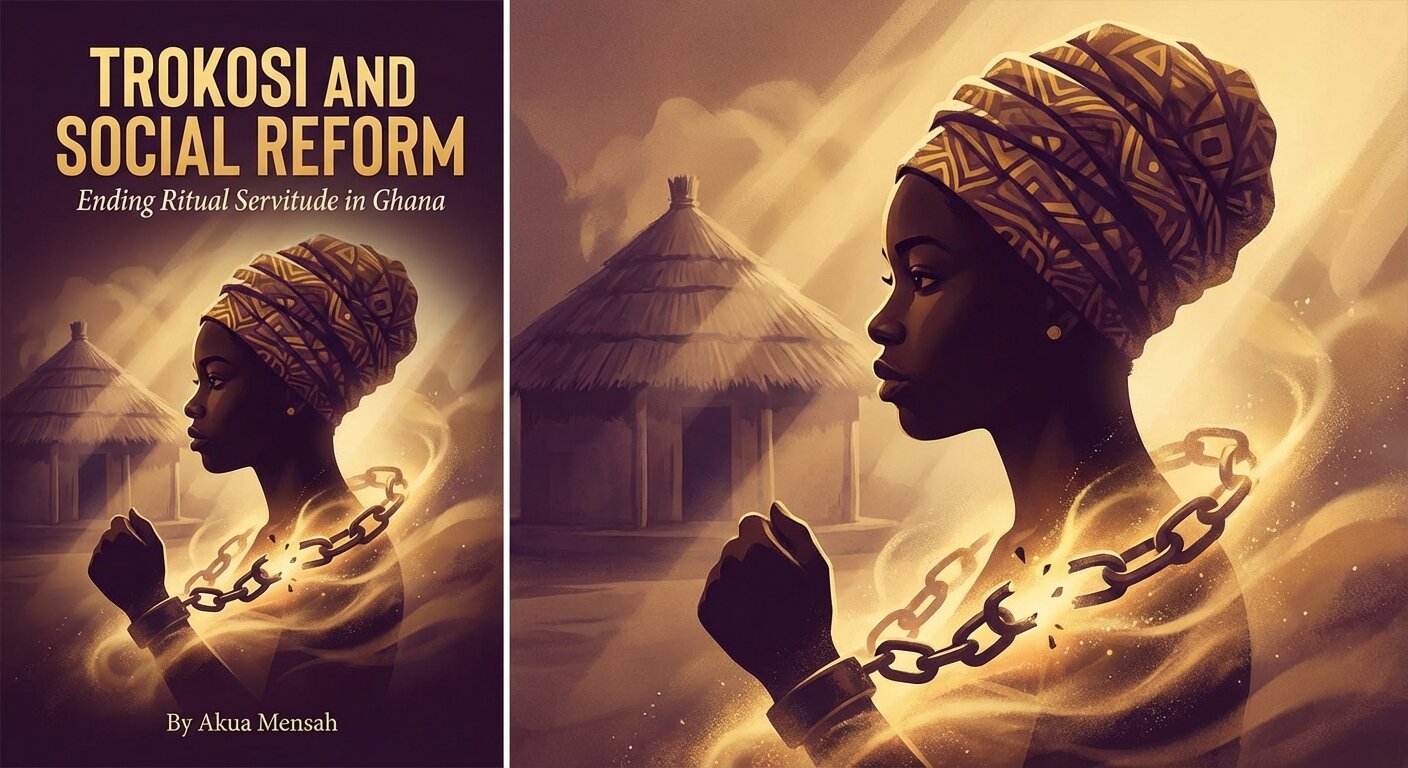
This study delves into the deeply entrenched practice of Trokosi (also referred to as Fiashidi or Woryokwe), a form of ritual servitude historically prevalent among the Ewe people of Ghana, particularly in the Volta Region and parts of Togo and Benin. It meticulously traces the evolution of this practice, where young girls and women are offered to traditional shrines as atonement for perceived transgressions of their families, or to appease the gods. The girls then serve the priests and shrines, often for life, and are subjected to forced labor, restricted movement, and various forms of exploitation, including sexual abuse. The book underscores the stark contrast between the spiritual beliefs underpinning Trokosi and the fundamental human rights it violates. It highlights the complex interplay of traditional beliefs, socio-economic factors, and gender inequality that perpetuated the system for generations. It details the historical justifications offered by practitioners, rooted in ancestral traditions and the belief that these practices maintain social order and spiritual harmony. Crucially, the work charts the rise of social reform movements spearheaded by Ghanaian and international organizations. International Needs Ghana emerges as a central figure, actively working to rescue enslaved girls, provide them with education and vocational training, and advocate for legislative change. The book meticulously documents the strategies employed by these organizations -- community sensitization, legal advocacy, and collaboration with traditional leaders who recognized the injustice of Trokosi. A pivotal moment in the fight against Trokosi was the amendment of the Ghanaian Criminal Code in 1998, which explicitly criminalized the practice. The book analyzes the legislative process, the debates surrounding the amendment, and its immediate and long-term impact. It acknowledges that while the law represents a significant victory, the complete eradication of Trokosi remains a challenge due to deeply ingrained cultural practices and the continued influence of traditional beliefs in certain communities. The text also examines the ongoing efforts to address the root causes of Trokosi, including poverty, lack of education, and limited opportunities for women. It explores the role of sustainable development programs in empowering communities and providing alternatives to the traditional practices that perpetuate ritual servitude. Readers will gain an understanding of the complexities of dismantling deeply ingrained cultural practices and the critical role of grassroots activism, legal reform, and socio-economic empowerment in achieving lasting change.
About the Author
Documenting and interpreting practices like Trokosi relies on a diverse body of scholarship that bridges anthropology, sociology, legal studies, and history. Oral histories and ethnographic research are crucial, capturing the experiences of Trokosi girls and women and the perspectives of community members. Ghanaian scholars, often working in collaboration with international researchers, have played a critical role in bringing these stories to light. Furthermore, legal scholars have analyzed the impact of legislation and international human rights law on addressing traditional practices that violate fundamental rights. Much of this research is ethically fraught, requiring careful attention to the safety and privacy of those affected, and to the potential for misrepresentation or cultural appropriation. The work builds on a tradition of social justice advocacy and critical engagement with harmful cultural practices.
Key Themes
- Ritual Servitude
- Human Rights
- Social Reform
- Gender Inequality
- Traditional Beliefs
- Legislative Advocacy
- Cultural Change
Why This Matters
The story of Trokosi and its eventual criminalization is vital for understanding the ongoing tension between cultural preservation and universal human rights in Ghana and across Africa. It demonstrates the power of collective action and legal reform in addressing deeply entrenched social injustices. This topic remains relevant today because ritual servitude, while outlawed, may still exist in clandestine forms, and because the underlying issues of poverty, gender inequality, and harmful traditional practices persist. Engaging with this history allows the diaspora to understand the complexities of modern Ghana beyond simplistic narratives of tradition versus modernity. For students, it offers a compelling case study in social change, human rights advocacy, and the challenges of balancing cultural sensitivity with universal ethical principles. Understanding Trokosi sheds light on the ongoing need for vigilance and continued efforts to safeguard the rights and dignity of all individuals.
Historical and Cultural Context
The struggle against Trokosi resonates with broader themes in African history, particularly the fight against slavery and other forms of forced labor. While the transatlantic slave trade is widely known, internal forms of servitude, often rooted in customary practices, have also existed across the continent. The campaign to end Trokosi mirrors similar efforts to eradicate child marriage, female genital mutilation, and other harmful traditional practices. The focus on legal reform and international human rights norms also connects to the broader Pan-African movement's emphasis on self-determination and social justice.
Sources & References
- Asare, W. P. B. (2001). The Trokosi System in Ghana: A Human Rights Perspective. International Needs Ghana.
- Ghanaian Ministry of Justice (1998). Criminal Code (Amendment) Act, 1998 (Act 554). Government of Ghana.
- Nukunya, G. K. (2003). Traditional Law and Human Rights in Ghana: The Case of Trokosi. Journal of African Law, 47(1).
- Antwi, M. A. (2010). Ending Ritual Servitude: The Campaign Against Trokosi in Ghana. Africa Today, 57(1).
- International Needs Ghana (Various Reports). Progress on Trokosi Eradication. Accra, Ghana.


'/%3E%3Crect width='900' height='1200' fill='url(%23p)' opacity='.7'/%3E%3Ctext x='450' y='560' text-anchor='middle' font-size='140' font-family='serif'%3E%E2%AD%90%3C/text%3E%3Ctext x='450' y='680' text-anchor='middle' fill='%23fff3c4' font-size='54' font-family='Georgia,serif' font-weight='700'%3ESankofa Library%3C/text%3E%3Ctext x='450' y='745' text-anchor='middle' fill='%23fff3c4' fill-opacity='.8' font-size='30' font-family='Arial,sans-serif'%3ECover under review%3C/text%3E%3C/svg%3E)