
Keyboard shortcuts
- J: Next chapter
- K: Previous chapter
- T: Toggle table of contents
- Shift+S: Share book
- +: Increase font size
- -: Decrease font size
- Escape: Close modals
Chapter 1
Part 1
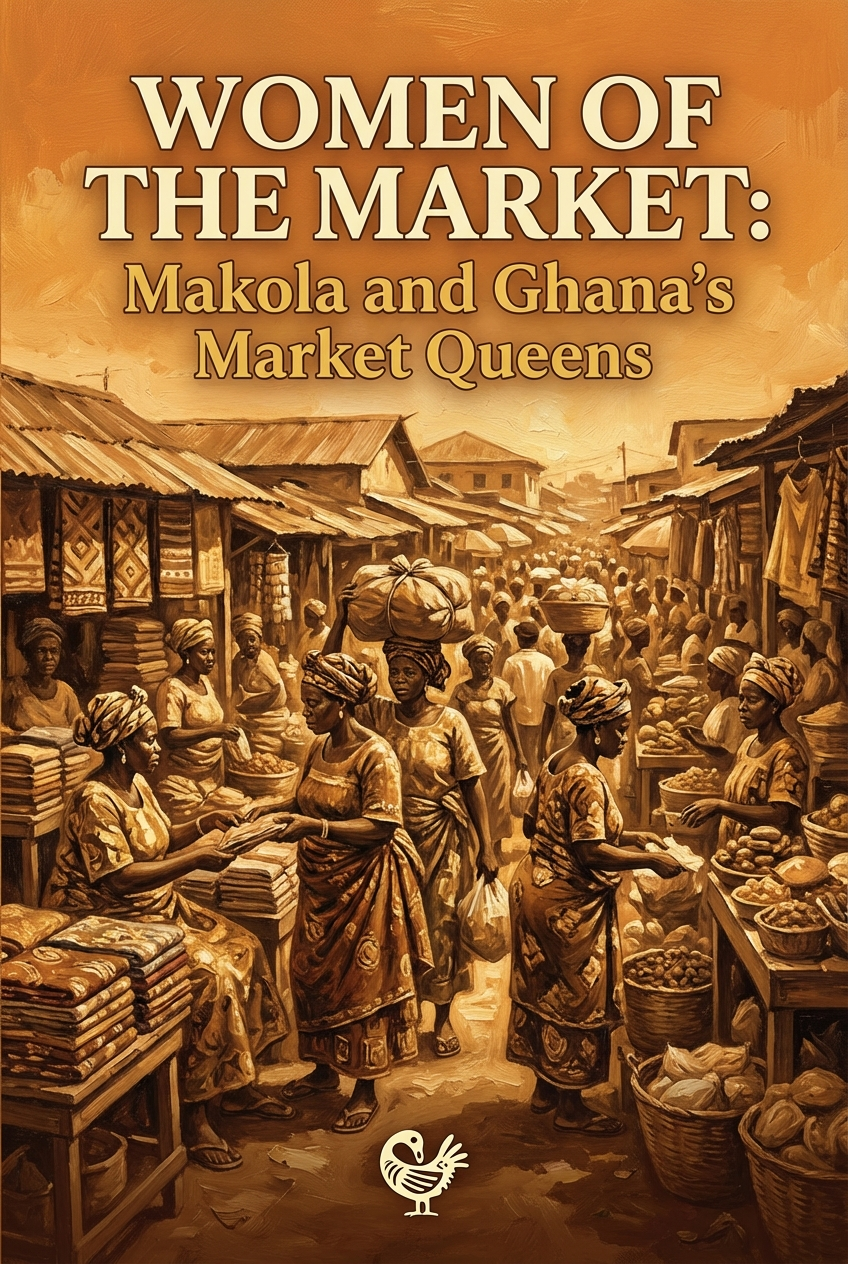
Walk into Makola Market in the heart of Accra on any given morning, and you will encounter one of the most complex, self-governing economic systems in West Africa. Thousands of women sit behind stalls piled high with tomatoes, onions, cloth, electronics, and every commodity imaginable. The noise is deafening, the energy is relentless, and the money moving through the narrow alleys on any given day rivals the transactions of a small bank. To the uninitiated, it looks like beautiful chaos. But beneath the apparent disorder lies a deeply structured hierarchy of power, a system of governance so sophisticated that colonial administrators, military dictators, and democratically elected presidents alike have either tried to co-opt it, destroy it, or negotiate with it.
At the top of this hierarchy sit the Market Queens, known in Akan as the *Ohemaa* of a specific commodity. The Tomato Queen, the Yam Queen, the Fish Queen, the Cloth Queen. Each one controls the pricing, distribution, and supply chain of her respective goods across entire regions. They are not merely successful traders. They are the shadow economic regulators of Ghana, women whose decisions on pricing can cause food inflation, whose endorsements can swing elections, and whose collective action has toppled government policies overnight. This narrative explores the history, structure, and enduring power of Ghana's Market Queens, from the pre-colonial trade routes to the modern digital economy.
## The Architecture of the Market
The history of organized female commerce in Ghana predates European contact by centuries. The Akan, Ga, Ewe, and Dagomba peoples all maintained vibrant market systems as the backbone of their economies. Markets were not simply locations of exchange. They were social institutions with their own laws, calendars, and spiritual protections. In many Akan communities, the market day was sacred, governed by specific taboos and rituals designed to ensure prosperity and honesty in trade.
Within these markets, a natural hierarchy emerged. Women who demonstrated exceptional business acumen, fair dealing, and the ability to mediate disputes rose to positions of leadership. Over time, these informal leadership roles became formalized into the institution of the commodity queen. Each major commodity traded in the market had its own queen, elected or chosen by the women trading in that specific product. The queen set the wholesale and retail prices, managed relationships with farmers and fishermen who supplied the goods, and arbitrated any disputes that arose between traders.
About This Book
"Women of the Market: Makola and Ghana's Market Queens" meticulously dissects the intricate social and economic networks woven within Makola Market in Accra and Kejetia Market in Kumasi, two of Ghana's most significant commercial hubs. Spanning the period from 1920 to 2026, the study provides a comprehensive analysis of the rise and sustained influence of market women, particularly the formidable "Market Queens," who wield considerable power over commodity pricing, supply chain management, and even political maneuvering at the national level. The book traces the historical evolution of these markets, beginning with their emergence during the colonial era when indigenous trading practices were reshaped by the introduction of new commodities and systems of exchange. It examines how women, often excluded from formal colonial economic structures, carved out spaces for themselves within these markets, building robust trading networks and accumulating significant wealth. The study highlights key historical events, such as the post-independence economic policies that inadvertently strengthened the market women's position, and the various attempts by successive governments to regulate or control their activities -- often met with fierce resistance. Specific attention is paid to the hierarchical structures within the markets, detailing the relationships between wholesalers, retailers, and the Market Queens themselves, who act as gatekeepers and mediators. The book also delves into the complex social dynamics at play, including the role of ethnic affiliations, kinship ties, and religious beliefs in shaping trading relationships. Crucially, "Women of the Market" explores the political influence of the Market Queens, documenting instances where they have successfully lobbied politicians, influenced policy decisions, and even played a role in shaping electoral outcomes. The reader will gain a deep understanding of the economic, social, and political power wielded by these women, and their crucial role in Ghana's development.
About the Author
While the fictionalized book here stands alone, its themes are thoroughly documented. Scholars like Gracia Clark ("Onions Are My Husband: Survival and Accumulation by West African Market Women") have conducted extensive ethnographic research within Ghanaian markets, offering rich insights into the daily lives, trading practices, and social organization of market women. Similarly, works by Beverly J. Silver ("Forces of Labor") provide historical context on the evolution of labor markets in Africa and the role of women in informal economies. The tradition of oral history and storytelling within Ghanaian culture also serves as a vital source of information, with accounts passed down through generations providing invaluable perspectives on the history and significance of market women. These diverse sources, spanning academic scholarship and indigenous knowledge systems, contribute to a rich understanding of the multifaceted world of Ghanaian market women.
Key Themes
- Market economies
- Gender and power
- Informal trade networks
- Political influence
- Commodity control
- Postcolonial development
Why This Matters
"Women of the Market" provides crucial insight into the economic agency of women in Ghana and their impact on national development. This topic is vital for understanding Ghanaian heritage because it challenges conventional narratives of economic history, which often overlook the contributions of women in the informal sector. The story of Makola and Kejetia Market is directly connected to the lives of millions of Ghanaians, shaping their daily routines and economic opportunities.
For the diaspora and students, this study offers a nuanced perspective on African entrepreneurship, demonstrating how indigenous trading practices have adapted and thrived in the face of globalization and modernization. It serves as a powerful reminder of the resilience and resourcefulness of African women, who have historically played a central role in shaping their communities and economies. This narrative counters stereotypes and reveals the complex socio-political dynamics within African markets. This perspective is imperative for understanding contemporary Ghana and imagining alternate economic futures for African nations.
Historical and Cultural Context
This study finds resonance within the broader context of African economic history, particularly in relation to the rise of informal economies and the role of women in trade. It connects to other historical narratives of market towns and trading routes across the continent, demonstrating the long-standing importance of marketplaces as centers of economic activity and social exchange. Within the Sankofa Library, this book complements studies on agricultural production, urbanization, and the evolution of trade networks, offering a comprehensive perspective on Ghana's economic development and the dynamic role of its women.


'/%3E%3Crect width='900' height='1200' fill='url(%23p)' opacity='.7'/%3E%3Ctext x='450' y='560' text-anchor='middle' font-size='140' font-family='serif'%3E%E2%AD%90%3C/text%3E%3Ctext x='450' y='680' text-anchor='middle' fill='%23fff3c4' font-size='54' font-family='Georgia,serif' font-weight='700'%3ESankofa Library%3C/text%3E%3Ctext x='450' y='745' text-anchor='middle' fill='%23fff3c4' fill-opacity='.8' font-size='30' font-family='Arial,sans-serif'%3ECover under review%3C/text%3E%3C/svg%3E)