Keyboard shortcuts
- J: Next chapter
- K: Previous chapter
- T: Toggle table of contents
- Shift+S: Share book
- +: Increase font size
- -: Decrease font size
- Escape: Close modals

Cover: Own work CC BY-SA 4.0 via Wikimedia Commons
Adorning the Ancestors, Embodying the Divine: The Enduring Legacy of Krobo Beadcraft in Pre-Colonial Ghana
- Krobo people
- Beads
- Beadmaking
- Powdered Glass
- Dipo
- Adornment
- Cultural Heritage
- Eastern Region
- Trade
- Pre-colonial Ghana
- Indigenous Craft
Chapter 1
The Genesis of Luminescence: Origins and Spiritual Foundations of Krobo Beads
The story of Krobo bead-making begins not merely with the creation of beautiful objects, but with the very genesis of the Krobo people and their profound connection to the land and the spiritual world. Oral traditions recount the migration of the Krobo from their ancestral home, believed to be further east, to their present location in the Eastern Region of Ghana, establishing their distinct cultural identity around the 15th century. It was within this rich cultural tapestry that beadcraft emerged, intertwined with their cosmogony and reverence for nature. Early beads were likely crafted from natural materials such as shells, seeds, and bone, serving as protective amulets and markers of spiritual connection long before the advent of glass.
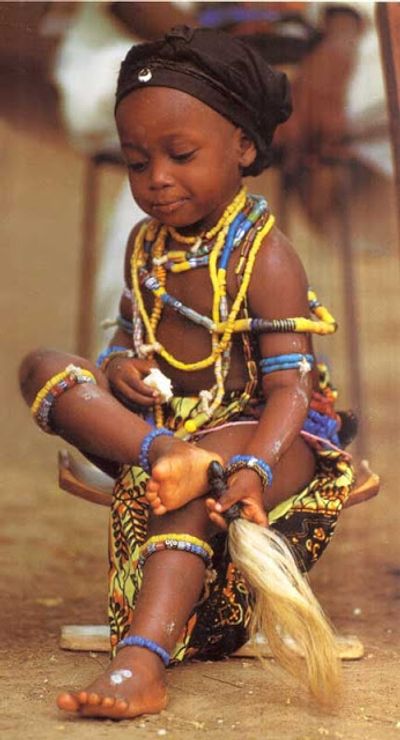
The spiritual significance of beads for the Krobo people is deeply embedded in their worldview. Beads were not merely decorative; they were believed to possess 'nya' or spiritual power, acting as intermediaries between the living and the ancestral spirits, and even deities. The earth itself, from which the raw materials were drawn, was considered sacred, and the process of bead-making was often accompanied by rituals and prayers. Certain ancient beads, like the revered 'bodom' beads, were thought to be gifts from the gods, unearthed from sacred sites, and were thus imbued with immense spiritual potency. These beads became heirlooms, passed down through generations, carrying the blessings and wisdom of the ancestors, and serving as tangible links to their lineage.
Moreover, beads played a crucial role in Krobo creation myths and the establishment of societal norms. They were seen as symbols of life, fertility, and the cyclical nature of existence. The colors and patterns of beads often mirrored elements of the natural world – the sky, the earth, water, and fire – reflecting a holistic understanding of the universe. This deep spiritual foundation ensured that bead-making was not just an economic activity or an artistic pursuit, but a sacred duty, preserving cultural memory and reinforcing the spiritual bonds that held the Krobo community together. The very act of wearing beads was a declaration of identity, a connection to the divine, and a participation in the enduring legacy of their ancestors.
Sources & References
- Ross, Doran H. "Beads of Ghana." UCLA Fowler Museum of Cultural History, 1998.
- Huber, Hugo. "The Krobo: Traditional Social and Religious Life of a West African People." The Catholic University of America Press, 1963.
- Quarcoopome, Nii O. "The Culture of Beads in Ghana." Africa World Press, 2008.
- Boahen, A. Adu. "Ghana Before the Europeans: The Pre-colonial Civilizations." Longman, 1966.