Keyboard shortcuts
- J: Next chapter
- K: Previous chapter
- T: Toggle table of contents
- Shift+S: Share book
- +: Increase font size
- -: Decrease font size
- Escape: Close modals
Beads of Fire and Memory: The Krobo Glass Bead Tradition and the Art of Adornment in Ghana
- krobo
- beads
- glass
- dipo
- art
Chapter 1
Glass from the Earth: The Ancient Origins of Krobo Bead-Making
The earliest powder glass beads found in Africa date to between 970 and 1000 CE, discovered at the archaeological site of Mapungubwe in present-day South Africa. But it is in Ghana's Eastern Region, among the Krobo people settled around the Krobo Mountain (Klowem) near Odumase and Somanya, that powder glass bead-making achieved its most refined and continuous expression. John Barbot, a French slave trader and chronicler, first documented bead production on the Gold Coast in his 1732 publication 'A Description of the Coasts of North and South Guinea,' noting that 'the natives make beads of their own' — the earliest European reference to indigenous glass bead manufacture in West Africa.
The Krobo — a Dangme-speaking people who migrated to the Accra Plains as part of the broader Ga-Dangme dispersal — settled the steep-sided Krobo Mountain (Shai and Krobo Hills) perhaps as early as the 14th century. The mountain served as a natural fortress, and the Krobo developed a reputation as fierce defenders of their territory, resisting both Ashanti and Akwamu incursions. Bead-making appears to have evolved from the recycling of European trade beads, particularly the brightly coloured Venetian millefiori, chevron, and aggrey beads that flooded the Gold Coast from the 15th century onward as currency in the slave and gold trades. R.S. Rattray, the British anthropologist who spent decades among the Ashanti, documented Krobo bead-making in the 1920s, though he noted that the craft was 'clearly of considerable antiquity.'
The raw material tells a colonial story in miniature. Early Krobo beads were made from fragments of European trade beads, themselves manufactured in Murano (Venice), Bohemia, and Amsterdam. As the trade bead supply diminished after abolition, Krobo craftsmen adapted, using broken bottles, medicine jars, and window glass imported by colonial merchants. Cobalt blue medicine bottles produced particularly prized beads; green glass from gin and wine bottles became staple material. The transformation of European refuse into African art objects carries a profound symbolic weight that scholars like Kwame Anthony Appiah have noted: 'The Krobo literally remade European material culture into something entirely their own.'
About This Book
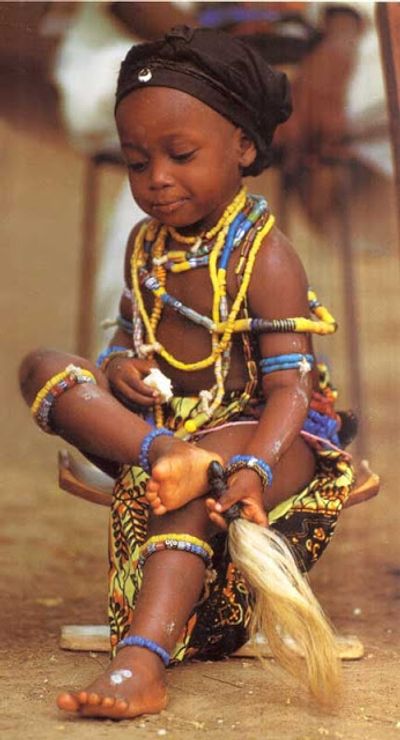
"Beads of Fire and Memory" unveils the captivating history of Krobo glass beads, tracing their origins from the 17th century to their contemporary global presence. The book delves into the ingenious techniques employed by Krobo artisans in Odumase Krobo, who transformed discarded European glass into exquisite beads, a process shrouded in cultural significance and imbued with ancestral knowledge. The narrative explores the complex relationship between the Krobo people and European traders, examining how this exchange shaped economic structures and artistic innovation. Crucially, the book emphasizes the role of beads as more than mere adornment. They are presented as potent symbols of status, identity, and spiritual power. Readers will learn about "Mue Yo," the coming-of-age ceremony for Krobo women, where elaborate beadwork plays a central role in signifying their transition to womanhood and their connection to ancestral lineages. The book also explores the symbolic language embedded within bead colors, patterns, and arrangements, revealing how beads communicate stories, proverbs, and historical narratives. The book addresses the challenges and transformations faced by the Krobo bead industry throughout history, from the impact of colonialism on trade routes to the emergence of mass-produced imitations. It examines how Krobo artisans have adapted and innovated to preserve their cultural heritage in the face of globalization, balancing tradition with modernity. Finally, the book highlights the increasing recognition of Krobo beads as valuable art objects, showcased in museums and worn by people across the world, celebrating their enduring legacy and cultural significance. Through archival research, oral histories, and visual documentation, "Beads of Fire and Memory" provides a comprehensive and engaging exploration of a vital aspect of Ghanaian cultural heritage.
About the Author
The study of Krobo beads has benefited from the work of dedicated historians, anthropologists, and art scholars. Pioneers like Marion Johnson contributed significantly to understanding the economic and social context of bead trade in West Africa. Later, scholars such as Michel Boserup have explored the symbolism and cultural significance embedded within Krobo bead traditions, documenting the artistry and knowledge systems of Krobo craftspeople. The field also draws on ethnographic research conducted by scholars like Professor Doran Ross, who meticulously documented Krobo coming-of-age ceremonies and the associated beadwork. Oral histories collected from Krobo beadmakers themselves form a vital part of the scholarly record, providing invaluable first-hand accounts of techniques, traditions, and the evolving role of beads in Krobo society. The scholarship on Krobo beads is a testament to the enduring importance of interdisciplinary research in understanding African material culture.
Key Themes
- Cultural innovation
- Trade and exchange
- Krobo identity
- Gender and ritual
- Artisanal knowledge
- Colonial impact
Why This Matters
The story of Krobo beads is essential for understanding Ghanaian and African heritage because it reveals the dynamic interplay between tradition, innovation, and cultural resilience. It demonstrates how African artisans adapted external influences -- in this case, European glass -- to create something distinctly their own, imbued with local meanings and artistic expression. This narrative challenges simplistic notions of cultural exchange as a one-way process and showcases the agency of African communities in shaping their own cultural landscape.
For the diaspora, the story offers a powerful connection to ancestral creativity and ingenuity. It highlights the sophistication and enduring legacy of African artistry. For students, the Krobo bead tradition provides a compelling case study of how material culture can serve as a repository of history, social values, and spiritual beliefs. Understanding the beads' intricate designs and their role in Krobo society offers insight into a rich tapestry of cultural practices.
Historical and Cultural Context
The Krobo bead tradition exists within a broader context of beadmaking and adornment across Africa. From ancient Egyptian faience beads to the intricate glass beads of Ile-Ife, beads have long served as symbols of status, spirituality, and social connection. The story of Krobo beads also intersects with the history of trade routes across the Sahara and the Atlantic, highlighting the interconnectedness of African societies and their engagement with global economic systems. Within the Sankofa Library, this study compliments works on Akan goldweights, textiles, and other forms of material culture.
Sources & References
- Wikipedia
- John Barbot
- R.S. Rattray
- Bureau of Ghana Languages