Keyboard shortcuts
- J: Next chapter
- K: Previous chapter
- T: Toggle table of contents
- Shift+S: Share book
- +: Increase font size
- -: Decrease font size
- Escape: Close modals
Asase Yaa's Bounty: Ethnomedicine, Ancestral Knowledge, and the Healing Tapestry of Pre-Colonial Ghana
- Traditional Ghanaian Medicine
- Herbal Healing
- Ethnobotany
- Pre-Colonial Ghana
- Akan
- Ewe
- Dagomba
- Spirituality
- Okomfo
- Asase Yaa
Chapter 1
The Cosmic Web of Healing: Worldview and Wellness in Ancient Ghana
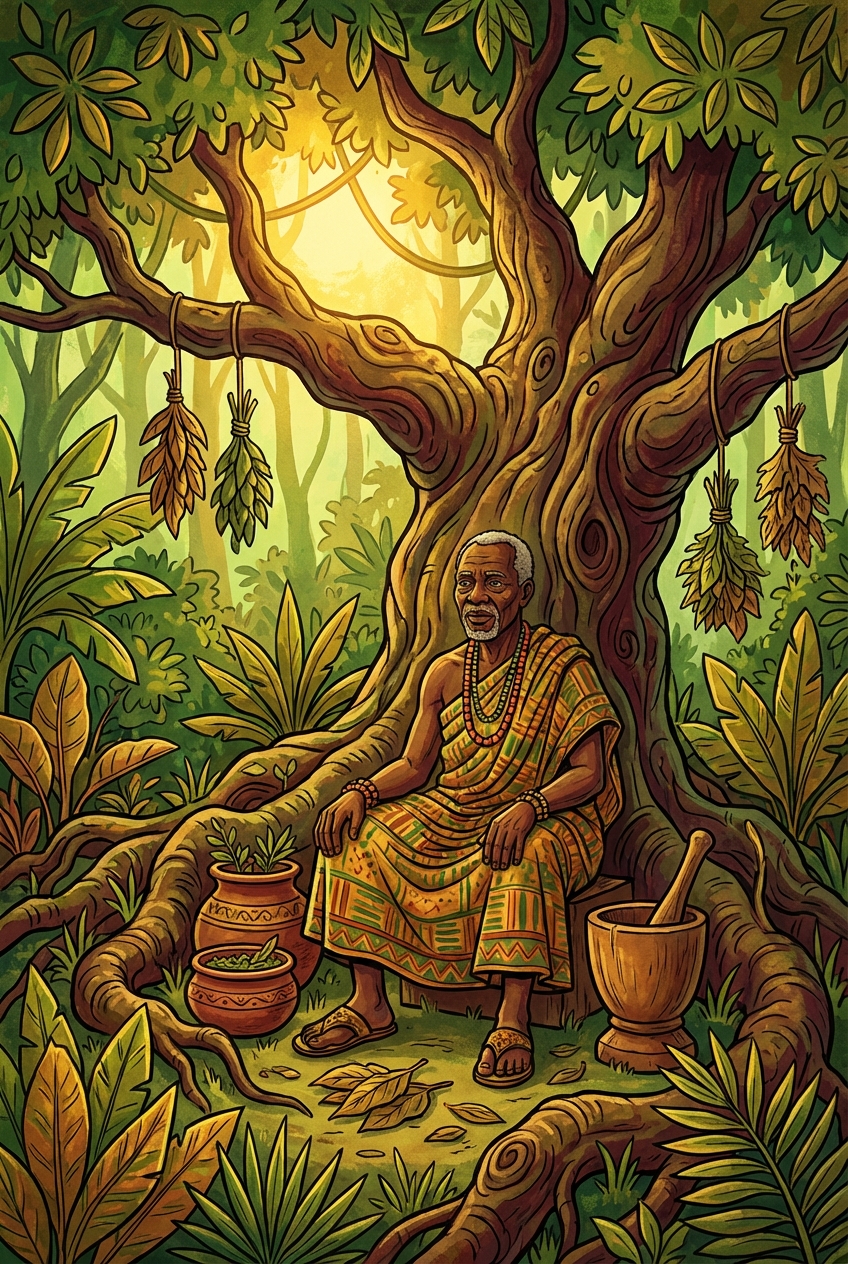
In pre-colonial Ghanaian societies, the concept of health transcended mere physical well-being; it was intrinsically linked to a holistic worldview where the visible and invisible realms intertwined. Communities across the forest and savannah, from the Akan to the Ewe and Dagomba, believed that illness often stemmed from spiritual imbalance, ancestral displeasure, or a breach of natural laws. The Earth Mother, often revered as Asase Yaa among the Akan, was seen as the ultimate provider of healing plants and the sacred ground upon which life unfolded. Any disrespect shown to her or the ancestors could manifest as sickness, crop failure, or communal strife. Thus, healing was not just about treating symptoms but about restoring harmony across all dimensions of existence – physical, psychological, social, and spiritual. Ancestral spirits, deities (Abosom among the Akan, Trowo among the Ewe), and nature spirits were integral to this cosmic web, influencing health and disease. Healing rituals, therefore, often involved appeasing these entities, seeking their guidance, or invoking their power to mend broken connections. This profound understanding meant that healers were not simply herbalists but spiritual intermediaries, diviners, and custodians of communal well-being, tasked with interpreting the unseen forces at play in a patient's affliction. This cosmic understanding formed the bedrock of all healing knowledge passed down through generations of Ghanaian practitioners.
About This Book
"Asase Yaa's Bounty" offers a comprehensive exploration of Ghanaian ethnomedicine before the impact of colonialism disrupted traditional practices. It investigates the Akan forest belt where sophisticated systems of herbal healing thrived, intertwined with reverence for Asase Yaa, the Earth Mother, and ancestral spirits. The book examines how illness was often viewed as a disruption of spiritual balance, requiring both herbal remedies and ritual interventions from priests (akɔmfoɔ) and healers. The reader will learn about specific plants used for various ailments -- from treating malaria (often with *Cryptolepis sanguinolenta*) to addressing fertility issues (with plants like *Clausena anisata*) -- and the protocols for their harvesting, preparation, and administration. Beyond the Akan areas, the book delves into the Volta Region, examining the Ewe understanding of health and disease, highlighting the role of *Mama Togbui* and *Papa Dzigbodi* in healing practices. In the Northern Savannah, the book explores the medical knowledge of the Dagomba, Mamprusi, Gonja, and Mole-Dagbani peoples, focusing on their unique understanding of the body, illness, and the influence of the spiritual world. It explores the role of traditional healers such as the *baga-baga* among the Mole-Dagbani, and the knowledge of local flora and fauna in medicinal practices. Important historical figures -- not necessarily medical practitioners themselves but influential in preserving or applying traditional knowledge -- are also considered. Okomfo Anokye, the influential priest and advisor to Asantehene Osei Tutu, is analyzed for his role in integrating spiritual beliefs with practical healing and statecraft. The book will also explore the role of women as key custodians of medical knowledge, from gathering and preparing herbs to diagnosing ailments and caring for the sick. The volume avoids romanticizing pre-colonial medicine, acknowledging the limitations and challenges inherent in these systems. Instead, it aims to provide a balanced and nuanced account of a complex and vital aspect of Ghanaian cultural heritage.
About the Author
The study of Ghanaian ethnomedicine has a rich, though often fragmented, history. Early observations were made by European travelers and missionaries, but these accounts are frequently colored by ethnocentric biases. Later, Ghanaian scholars such as Dr. J.B. Danquah, though not strictly focused on ethnomedicine, emphasized the importance of indigenous knowledge systems and Akan philosophy. More recently, researchers at institutions like the Kwame Nkrumah University of Science and Technology (KNUST) in Kumasi and the University of Ghana have been instrumental in documenting and analyzing traditional medical practices, often through fieldwork and interviews with traditional healers. The work of Dr. Oheneba Boachie-Adjei Woahene on herbal medicine and its potential for integration into modern healthcare is particularly noteworthy. This book draws upon this diverse body of scholarship, aiming to synthesize existing knowledge and offer new insights into the healing tapestry of pre-colonial Ghana.
Key Themes
- Herbal medicine
- Spiritual healing
- Ancestral veneration
- Indigenous knowledge systems
- Gender roles in healing
- Cosmology and health
- Regional variations in medical practices
Why This Matters
Understanding pre-colonial Ghanaian ethnomedicine is crucial for appreciating the depth and sophistication of indigenous knowledge systems. It challenges the often-held notion that African societies lacked sophisticated medical practices before European contact. For the Ghanaian diaspora, it provides a tangible link to ancestral heritage, fostering a sense of pride and connection to the land. For students, it offers a valuable perspective on the intersection of culture, history, and science, demonstrating the importance of considering diverse epistemologies. By understanding how our ancestors approached health and well-being, we can also critically evaluate contemporary healthcare systems and explore the potential for integrating traditional and modern medical practices, particularly in addressing health disparities and promoting culturally sensitive care. This topic matters because it restores agency to pre-colonial Ghanaians and highlights their intellectual and practical contributions to the world.
Historical and Cultural Context
This study of pre-colonial Ghanaian ethnomedicine resonates with broader themes in African history, such as the resilience of indigenous knowledge in the face of colonialism. It also connects to the larger narrative of African contributions to botany, pharmacology, and public health. In the Sankofa Library, this book complements works on traditional religion, social structures, and economic systems, offering a holistic view of pre-colonial Ghanaian life. It can be compared to other texts exploring traditional medicine in different African regions, allowing for a broader understanding of the diversity and ingenuity of African healing practices.
Sources & References
- Rattray, R. S. (1927). Religion and Art in Ashanti. Oxford University Press.
- Meyerowitz, E. L. R. (1951). The Sacred State of the Akan. Faber and Faber.
- Danquah, J. B. (1968). The Akan Doctrine of God: A Study in an African Philosophy and Religion. Frank Cass & Co.
- Warren, D. M. (1986). The Akan of Ghana: An Overview of the Ethnographic Literature. Centre of African Studies, University of Ghana.