Keyboard shortcuts
- J: Next chapter
- K: Previous chapter
- T: Toggle table of contents
- Shift+S: Share book
- +: Increase font size
- -: Decrease font size
- Escape: Close modals
Chapter 1
The Clash of Worlds: Shrines, Schools, and the Spiritual Battle for the Gold Coast
The Basel Mission did not arrive on neutral ground. The Akuapem Ridge was sacred territory governed by powerful obosom (deities) and tended by akomfo (priests) whose authority predated European contact by centuries. The collision between Christianity and indigenous religion was neither gentle nor one-directional. In the 1830s and 1840s, missionaries at Akropong confronted the annual Odwira festival — the great purification ceremony that renewed the bond between the living, the ancestors, and the land. Basel missionaries denounced Odwira as "heathen worship" and forbade converts from participating, creating painful rifts within families and lineages. The ohemaa (queen mother) of Akropong reportedly warned Riis: "You want to turn our children into strangers in their own homes."
The destruction of shrines became policy. In the 1850s and 1860s, newly converted Christians, often encouraged by missionaries, burned fetish groves, smashed sacred objects, and publicly defied traditional priests. At Odumase-Krobo in 1853, converts destroyed the shrine of Nana Kloweki, provoking a violent backlash from traditionalists. The colonial government occasionally intervened to keep the peace, but generally sided with the mission. The Krobo dipo ceremony — the female puberty rite central to Krobo identity — was targeted for abolition from the 1840s onward, though it proved remarkably resilient, surviving suppression to be revived in the 20th century.
Yet the relationship was not purely antagonistic. The missionaries adopted indigenous musical forms for their hymns, translating German chorales into Twi and Ga with local melodic patterns. Christaller recognised the philosophical depth of Akan proverbs, preserving thousands that Christian zealots might otherwise have dismissed. Some converts practised what scholars call "dual allegiance" — attending church on Sundays while quietly maintaining relationships with traditional healers and ancestors. The Presbyterian Church eventually developed a more nuanced approach, particularly after Ghanaian leadership took control in the 1920s, incorporating drumming and traditional instruments into worship and acknowledging the spiritual insights within indigenous cosmology.
The medical mission added another dimension to this encounter. The Basel Mission established dispensaries at Akropong and Christiansborg as early as the 1850s, introducing Western medicine alongside their evangelism. Dr. Rudolf Fisch served at Abetifi from 1888, documenting tropical diseases and traditional healing practices with unusual respect for local pharmacopoeia. The tension between mission medicine and traditional healing persists in Ghana to this day, but the mission hospitals — particularly Agogo Presbyterian Hospital (founded 1931) and Bawku Hospital — became pillars of healthcare in underserved regions, serving patients of all faiths.
About This Book
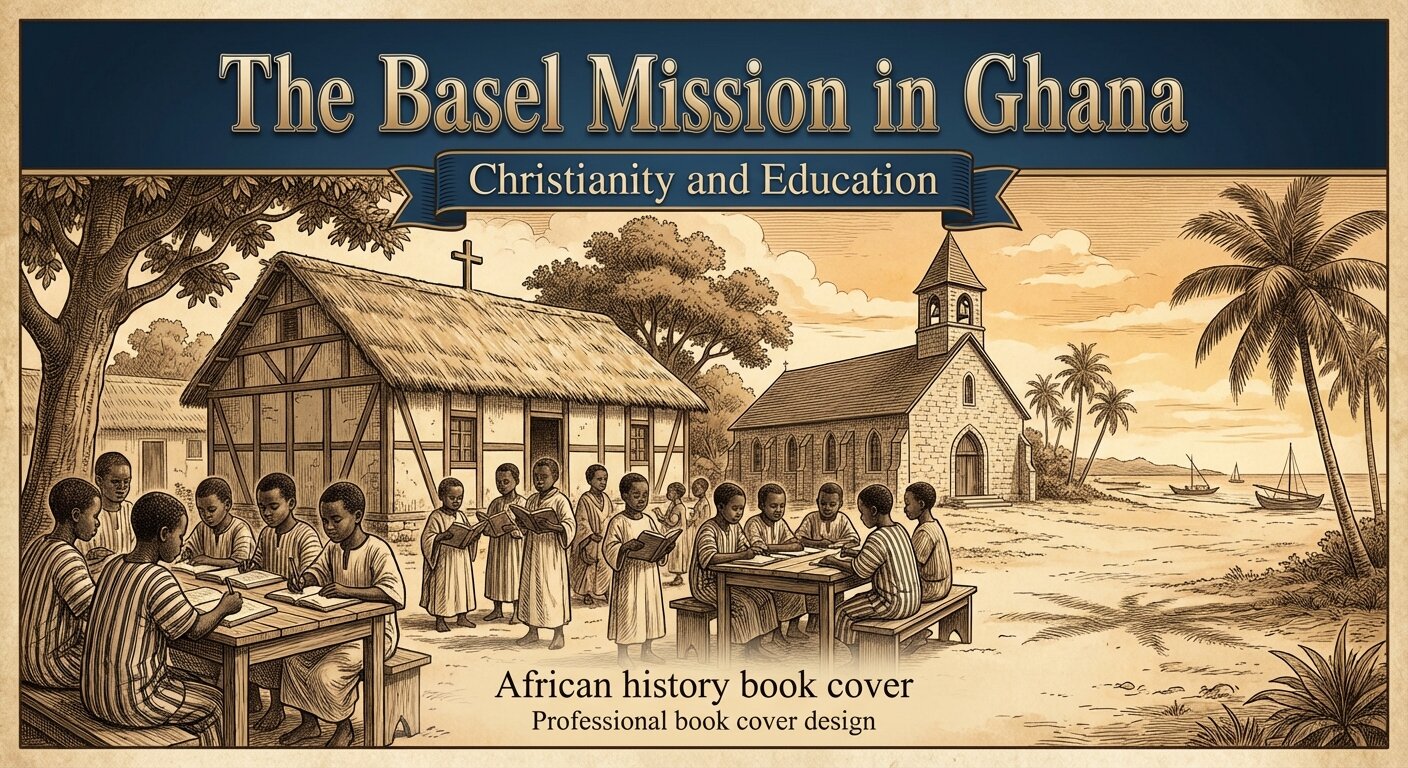
"The Basel Mission in Ghana: Christianity and Education" delves into the multifaceted impact of the Basel Mission -- later the Presbyterian Church of Ghana -- on the socio-cultural and intellectual landscape of pre-colonial and colonial Ghana. Arriving in 1828, these Swiss and German missionaries weren't merely purveyors of religious doctrine; they were pioneers in establishing formal Western-style education and engaging deeply with local languages and cultures. The text meticulously charts their initial struggles and subsequent successes in gaining converts, often encountering resistance and suspicion from traditional religious practitioners and those wary of foreign influence. A central theme is the mission's linguistic contributions. Faced with the challenge of evangelizing in local languages, missionaries dedicated themselves to learning and documenting languages like Twi, Ga, and Ewe. They developed written orthographies, translated the Bible, and produced dictionaries and grammars, profoundly impacting literacy and the preservation of these languages. The book meticulously explores the establishment of schools at various levels -- from primary schools in villages to teacher training colleges like Akropong -- which became vital centers for training future generations of Ghanaian educators, clergy, and administrators. Figures like Andreas Riis, Johann Gottlieb Christaller, and David Asante are prominently featured, highlighting their individual contributions to translation, education, and cultural understanding. Beyond formal education, the book acknowledges the complex relationship between the mission and Ghanaian society. While promoting Christianity, missionaries also engaged in economic activities, such as agriculture and trade, inadvertently contributing to economic development but also potentially altering traditional economic systems. The book also discusses the evolving relationship between the mission and the colonial administration, examining instances of collaboration and tension as both entities sought to shape the trajectory of Ghanaian society. Ultimately, the book aims to provide a nuanced understanding of the Basel Mission's legacy -- acknowledging its contributions to education and linguistic preservation while also critically examining its role within the broader context of colonialism and cultural change. Readers will gain insight into the complex interplay between faith, education, and colonial power in shaping modern Ghana.
About the Author
Scholarship on the Basel Mission in Ghana spans several generations and draws upon diverse perspectives. Early accounts were often written by the missionaries themselves, providing valuable primary source material but also reflecting their own biases and interpretations. Historians like Noel Smith, author of "The Presbyterian Church of Ghana, 1835-1960," have offered more critical and comprehensive analyses, placing the mission's activities within the broader context of Ghanaian history and colonial dynamics. Ghanaian scholars, such as Kwame Arhin, have enriched the field by providing indigenous perspectives on the mission's impact on local cultures and societies. More recent scholarship has focused on exploring the nuances of intercultural interactions, examining the agency of African converts and educators, and analyzing the mission's long-term legacy in shaping Ghanaian identity and development. This body of work underscores the enduring significance of the Basel Mission in shaping Ghana's religious, educational, and cultural landscape.
Key Themes
- Christian evangelism
- Western education
- Linguistic development
- Colonial impact
- Cultural exchange
- Economic development
Why This Matters
Understanding the Basel Mission's role in Ghana is crucial for grasping the complex interplay between colonialism, religion, education, and cultural change in Africa. The mission's efforts to establish schools and translate the Bible had a lasting impact on literacy, language preservation, and the development of a Western-educated elite in Ghana. Examining their work allows us to analyze the transmission of knowledge and values across cultures, and to grapple with the ambivalent legacy of colonialism -- the ways in which it brought new opportunities while simultaneously disrupting traditional ways of life.
For the diaspora and students, this topic offers insights into the roots of modern Ghana and its relationship with the West. Understanding the historical role of missions provides context for contemporary debates about religion, education, and development in Africa. It prompts critical reflection on the legacies of colonialism and the ongoing process of decolonizing knowledge and reclaiming African narratives. By engaging with this story, readers can gain a deeper appreciation for the resilience and agency of Ghanaians in shaping their own future in the face of external influence.
Historical and Cultural Context
The activities of the Basel Mission must be understood within the broader context of the 19th-century European missionary movement in Africa. Similar missions -- such as the Church Missionary Society (CMS) in Nigeria and the London Missionary Society (LMS) in Southern Africa -- also played significant roles in spreading Christianity and establishing schools. Comparing and contrasting the experiences of these different missions across the continent reveals broader patterns of colonial engagement and cultural exchange. Furthermore, within the Sankofa Library, this topic can be linked to other texts exploring the history of education, religion, and colonialism in Ghana and throughout the African continent.
Sources & References
- Akyeampong, E. (2006). Themes in West Africa History. James Currey.