Keyboard shortcuts
- J: Next chapter
- K: Previous chapter
- T: Toggle table of contents
- Shift+S: Share book
- +: Increase font size
- -: Decrease font size
- Escape: Close modals
Bono-Manso: The Cradle of Akan Civilization and the Kingdom That Forged a Cultural Legacy
↓Chapter 1
The Foundation: Chief Akumfi Ameyaw I and the Birth of the First Akan State (c.1450)
The founding of the Bono state is traditionally attributed to Nana Akumfi Ameyaw I, who reigned from 1328 to 1363 according to oral traditions preserved by contemporary Bono chiefs, particularly Nana Akumfi Ameyaw III, the current paramount chief who traces his lineage directly to the founding monarch. While the exact dating remains debated by historians, this 14th-century timeframe aligns with archaeological evidence of early urbanization in the Bono-Manso region and the broader context of state formation in the forest-savanna transition zone.
According to Bono oral history, the Akan peoples migrated southward from somewhere 'in the north'—variously identified in traditions as the Niger bend region, the area around ancient Ghana, or the savannas beyond modern Burkina Faso. The migrants, seeking refuge from conflicts, droughts, or opportunities for trade, moved in several waves, with different groups establishing settlements across what would become the Akan cultural zone.
The leader Nana Asaman is credited with founding Yefiri (present-day Nkoranza), while Bono-Manso was established to the west, strategically positioned to control gold deposits and kola nut forests while maintaining access to northern trade routes. The settlement pattern was deliberate: establishing towns at key resource points and trade junctions rather than in defensive hilltop positions, suggesting commercial rather than primarily military motivations.
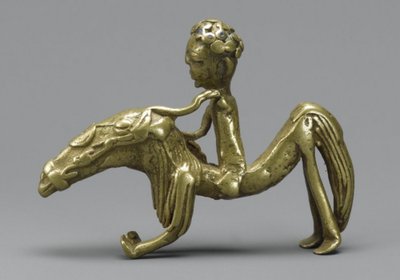
Akumfi Ameyaw I's most enduring innovation was the systematization of gold dust as currency, creating a standardized weight system using brass weights (abrammuo) based on the taku seed (Abrus precatorius, approximately 0.13 grams) as the base unit. This monetary system, which would later be adopted by Denkyira, Asante, and other Akan states, represented a technological and economic leap forward, facilitating trade across vast distances and enabling wealth accumulation in portable form.
The early Bono state also established the template for Akan political organization: a paramount chief (Bonohene) presiding over a confederation of towns and villages, each with its own chief owing allegiance to the center; a council of elders advising the paramount; the installation of a queen mother (Bonohemaa) wielding significant political authority; and the use of skilled okyeame (linguists) to mediate communication, preserve oral history, and conduct diplomatic relations. These institutions, refined over generations, would be transplanted by Bono migrants and adopted by emerging Akan states throughout the forest belt.
By the reign of Obunumankoma in the mid-to-late 15th century, Bono had expanded its territorial control and commercial reach, laying the foundation for its Golden Age in the 16th-17th centuries.
About This Book
"Bono-Manso: The Cradle of Akan Civilization and the Kingdom That Forged a Cultural Legacy" offers a profound exploration of the Bono Kingdom, a pivotal yet often overlooked force in shaping Akan identity and Ghanaian history. The book meticulously traces the kingdom’s rise from its mythical origins under Chief Akumfi Ameyaw I around the mid-15th century, detailing the establishment of Bono-Manso as its capital and the twin city of Begho as a bustling commercial center. Readers will learn how the Bono people, through innovative governance structures and astute economic strategies, laid the foundation for the Akan civilization that would subsequently spread across much of present-day Ghana. The narrative illuminates Bono's significant role in the Trans-Saharan trade network, emphasizing its control over lucrative gold and kola nut resources. The book details the complex trade relationships with North African merchants and the introduction of new technologies and ideas that impacted Bono society. It examines the political and social organization of the kingdom, including the role of the Queen Mother, the significance of ancestral shrines, and the administration of justice through traditional courts. The impact of Akan religious practices on governance is also explored. The study also analyzes the kingdom’s eventual decline, hastened by internal strife, economic competition from rising coastal states, and ultimately, the expansion of the Asante Kingdom. The book carefully evaluates how Bono's political and military institutions were adopted and adapted by the Asante, demonstrating a clear lineage of Akan statecraft. Furthermore, it analyzes the cultural legacy of Bono, particularly its influence on language, customs, and artistic traditions that persist among Akan peoples today. Readers will gain a deeper understanding of the complex interplay between historical forces and cultural innovation that shaped one of West Africa's most influential kingdoms.
About the Author
While the author is presented as the result of collective scholarship, the study of the Bono Kingdom has been shaped by various historians and oral traditions. Scholars such as Kwame Arhin have conducted extensive research on Akan political systems, providing valuable insights into Bono's governance structures. Oral traditions, passed down through generations of Bono elders and keepers of ancestral knowledge, have been crucial in preserving the kingdom's history. Archaeological excavations at Bono-Manso and Begho have further supplemented written and oral sources, offering material evidence of the kingdom’s prosperity and trade networks. The ongoing work of researchers at institutions like the University of Ghana's Institute of African Studies continues to contribute to our understanding of the Bono Kingdom and its lasting impact on Akan history.
Key Themes
- Akan Origins
- Trans-Saharan Trade
- Kingdom Building
- Cultural Diffusion
- Bono-Asante Relations
- Political Innovation
Why This Matters
The story of the Bono Kingdom is crucial for understanding Ghanaian and African heritage because it reveals the foundations upon which Akan identity was built. It challenges the Eurocentric view of African history by demonstrating the existence of complex and sophisticated societies prior to European contact. Its relevance today lies in its ability to inspire a sense of pride in African achievements and to foster a deeper appreciation for the diversity of African cultures. For the diaspora, this narrative provides a tangible link to their ancestral past and underscores the agency of African peoples in shaping their own history. Students, in particular, should engage with this story to gain a more nuanced understanding of African history, moving beyond simplistic narratives of colonialism and resistance to explore the dynamic processes of state formation and cultural exchange that characterized pre-colonial Africa.
Historical and Cultural Context
The rise and fall of the Bono Kingdom must be understood within the broader context of West African history during the pre-colonial era. It parallels the emergence of other influential kingdoms in the region, such as the Songhai Empire to the north and the Oyo Empire to the east, all of which were shaped by trade, migration, and political competition. Within the Sankofa Digital Heritage Library, the story of Bono connects with narratives of the Ashanti Empire. Examining the cultural and political influence of Bono on Asante provides a more complete picture of Akan history.