Keyboard shortcuts
- J: Next chapter
- K: Previous chapter
- T: Toggle table of contents
- Shift+S: Share book
- +: Increase font size
- -: Decrease font size
- Escape: Close modals
Chapter 1
Threads Before Memory: Archaeological Origins of Weaving in the Gold Coast
Long before the vibrant kente strips that would come to symbolise Ghanaian identity, the peoples of the Gold Coast interior were already weaving. Archaeological excavations at Begho — the great Akan trading town near modern Hwidiem in the Brong-Ahafo Region — have uncovered spindle whorls and dye pits dated to the 14th through 18th centuries, providing the earliest physical evidence of loom weaving in southern Ghana. At nearby Bono Manso, capital of the Bono Kingdom founded around 1295 CE, similar finds confirm that textile production was integral to the trans-Saharan trade economy that connected the forest zone to Jenne-Jeno and Timbuktu. Merrick Posnansky, who led the Begho excavations from 1970 to 1979 for the University of Ghana, identified cotton thread fragments alongside brass-working debris, suggesting that weaving workshops operated within the same artisan quarters as metalworkers and potters.
Further west at Wenchi, spindle whorls have been dated to the 16th and 17th centuries, establishing a geographic corridor of textile production stretching from the Bono heartland toward what would become Asante territory. The earliest looms were likely simple frame looms producing narrow strips of undyed cotton — white cloth that served as both everyday garment and burial shroud. The Akan word "ntama" (cloth) appears in some of the oldest recorded Twi vocabulary, catalogued by Johann Gottlieb Christaller in his 1881 Dictionary of the Asante and Fante Language, suggesting deep cultural embedding.
The trans-Saharan connection was critical. North African and Sahelian textiles — particularly Fulani blankets and Mande strip-woven cloth from the Kong and Bondoukou regions of modern Côte d'Ivoire — provided both competition and inspiration. Timothy Garrard, whose research on Akan trade is foundational, documented how Dyula Muslim traders brought not only gold-weighing technology but also weaving techniques southward through the trade towns of Begho, Bono Manso, and Nsoko. The narrow-strip loom itself is a West African innovation, fundamentally different from the broad-loom traditions of North Africa, and its distribution from the Senegambia to the Akan forests traces centuries of cultural diffusion along trade routes.
About This Book
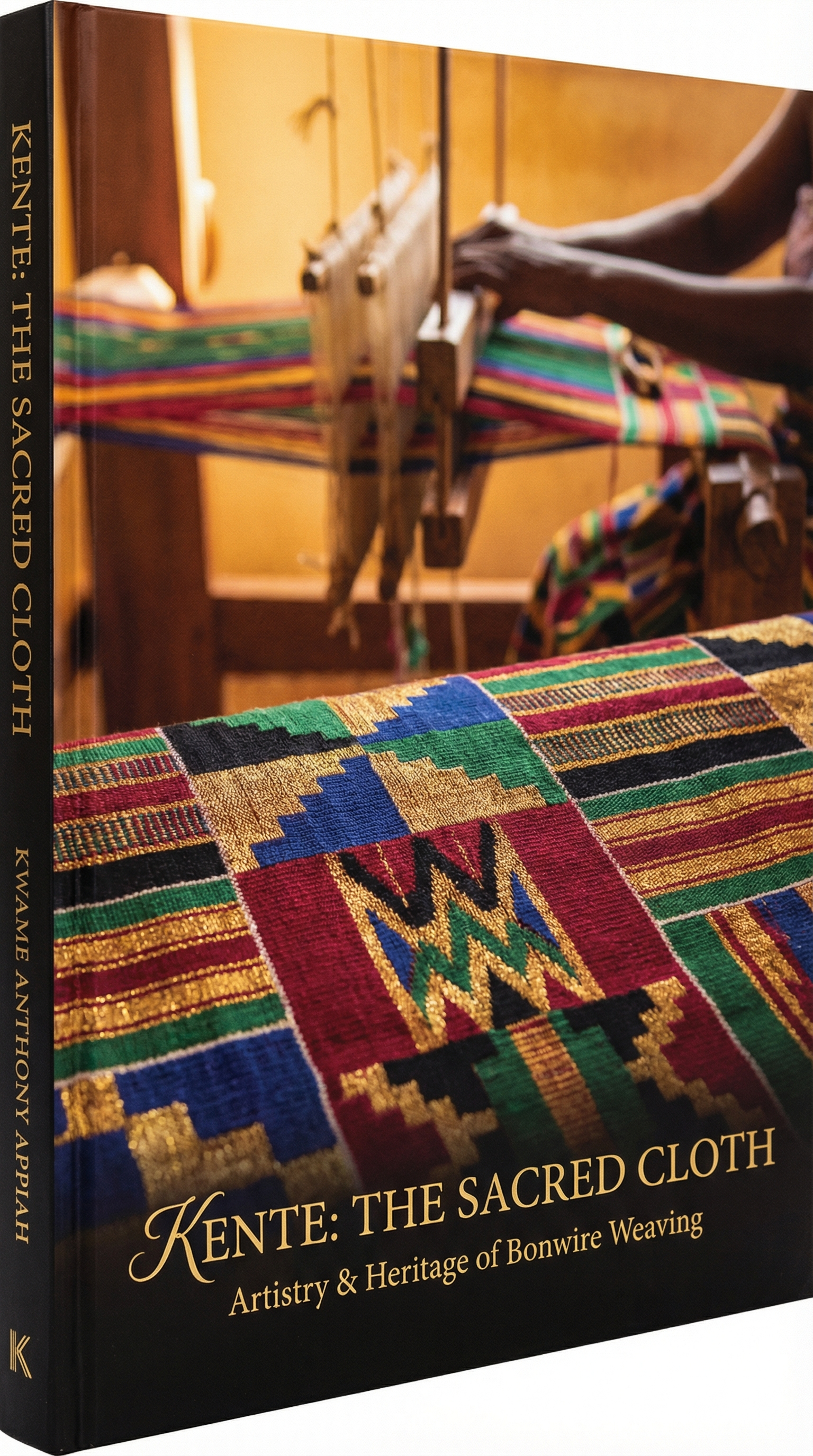
"Nwentoma: The Sacred Art of Kente Cloth, from Bonwire Looms to Global Icon" offers a journey into the profound cultural significance of Kente cloth, moving beyond its superficial perception as a mere textile. The book delves into the origins of Kente weaving among the Akan people, particularly the Asante, tracing its evolution from a royal prerogative to a widely recognized symbol of African identity and pride. It meticulously examines the oral traditions that surround the craft, connecting it to Ananse the Spider, the trickster figure whose weaving skills are believed to be the divine inspiration for human weavers. The book painstakingly details the complex process of creating authentic Kente, from the selection of raw materials to the intricate designs woven on traditional looms in Bonwire, the renowned Kente weaving center. It deciphers the language of Kente, explaining the symbolic meaning embedded within the colors and patterns. Readers will learn about the specific historical events and individuals associated with particular cloths, such as *Fathia Fata Nkrumah*, created to honor Ghana's First Lady, and *Oyokoman*, representing the unity and strength of the Asante nation. The work highlights the meticulous craftsmanship of the weavers and their deep understanding of cultural protocols, revealing how weaving is not merely a skill but a form of storytelling and historical preservation. Furthermore, the book explores the role of Kente in pre-colonial Asante society, illustrating how it served as a marker of status, power, and spiritual connection. It investigates the impact of colonialism on the industry and the subsequent adaptations and innovations that allowed Kente to survive and thrive. Finally, it examines the cloth's globalization, detailing its adoption as a symbol of Pan-Africanism and its contemporary use in fashion, art, and popular culture, solidifying its place as a potent emblem of African heritage and identity worldwide. Readers will gain a comprehensive appreciation for the historical, cultural, and artistic significance of Nwentoma.
About the Author
The scholarship surrounding Kente cloth draws from a rich tapestry of sources, including oral traditions passed down through generations of weavers, ethnographic studies conducted by anthropologists, and historical accounts documented by researchers and art historians. Figures like Dr. Boatema Boateng and Doran H. Ross, among others, have significantly contributed to the understanding of Kente's symbolism, production techniques, and cultural context. Their work has helped to move beyond simplistic representations of Kente, revealing its complex history and multifaceted significance. This book synthesizes these diverse perspectives, drawing upon archival research, interviews with master weavers, and critical analysis of existing literature to provide a comprehensive and nuanced account of Kente's enduring legacy. It stands on the shoulders of previous scholarship, aiming to deepen the appreciation for this sacred art form.
Key Themes
- Akan Weaving Traditions
- Symbolism of Color and Pattern
- Pre-Colonial Asante Culture
- Kente as a Symbol of Status
- Globalization of African Heritage
- Oral History and Storytelling
Why This Matters
Kente cloth is far more than just a beautiful textile; it is a tangible embodiment of Ghanaian and African history, philosophy, and cultural values. Understanding Kente provides a window into the complex social structures, spiritual beliefs, and artistic achievements of the Akan people, particularly the Asante. Its relevance today lies in its continued use as a powerful symbol of African pride, identity, and resilience.
For the diaspora, Kente serves as a vital link to their ancestral roots, offering a tangible connection to a rich cultural heritage that has endured through centuries of displacement and oppression. Students, particularly those studying African history, art, or culture, will find that understanding Kente provides valuable insights into the pre-colonial world, the impact of colonialism, and the ongoing struggle for cultural preservation and empowerment. By engaging with this story, readers gain a deeper appreciation for the depth and complexity of African heritage and its continued relevance in the contemporary world.
Historical and Cultural Context
The study of Kente is inextricably linked to broader themes within African history. It mirrors the development of complex pre-colonial kingdoms like Asante, their engagement with trade networks, and their resistance to colonial domination. Kente production was intricately tied to the slave trade, as captured Africans were sometimes forced to cultivate the cotton used in weaving. Within the Sankofa Digital Heritage Library, the study of Kente complements other resources on Akan oral traditions, Asante statecraft, and the Pan-African movement, providing a richer understanding of Ghana's historical and cultural contributions to the world. It provides context and insights into the economic and political realities of the era and its continuing social repercussions today.