Keyboard shortcuts
- J: Next chapter
- K: Previous chapter
- T: Toggle table of contents
- Shift+S: Share book
- +: Increase font size
- -: Decrease font size
- Escape: Close modals
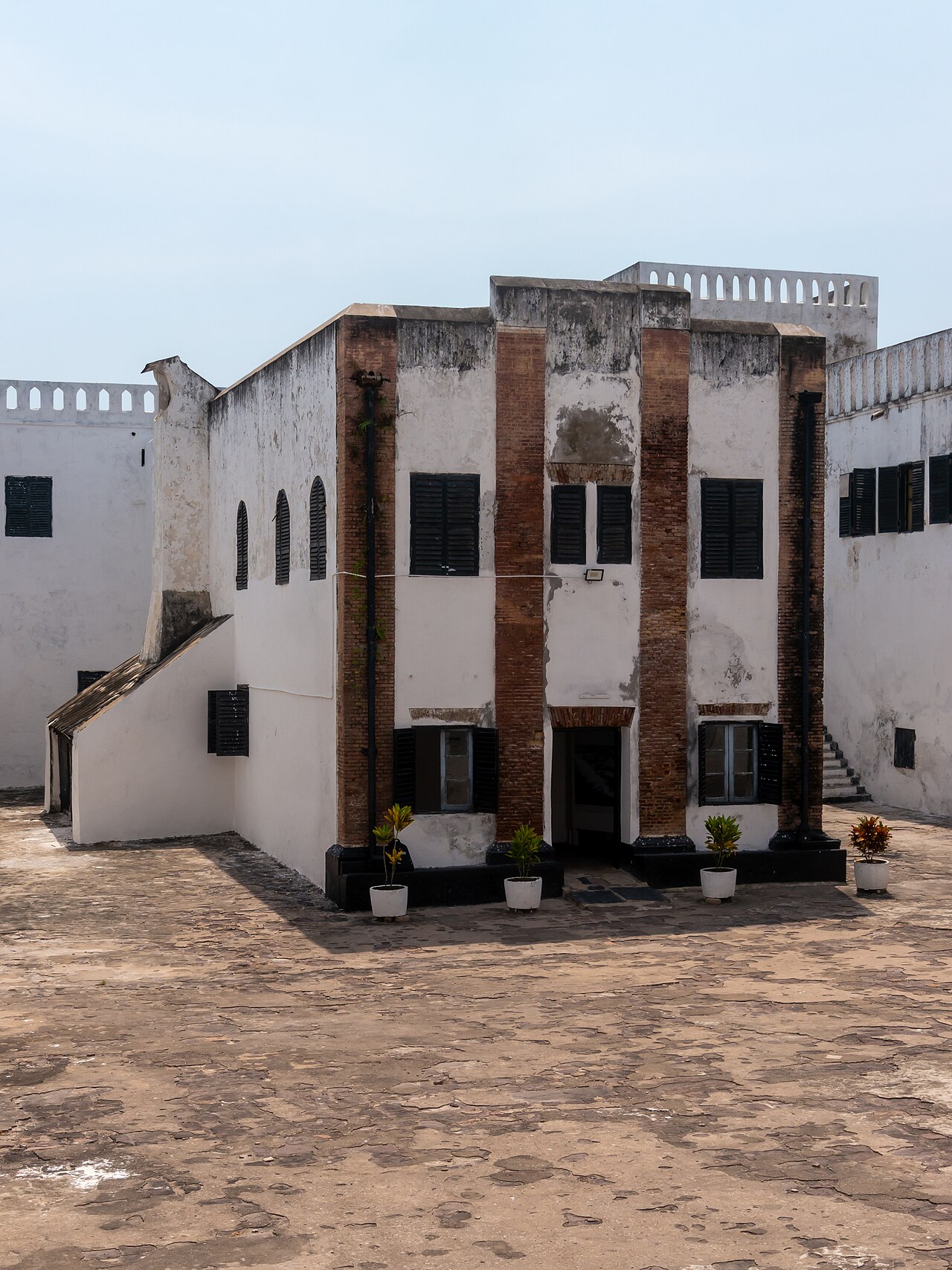
Cover: Own work CC BY-SA 4.0 via Wikimedia Commons
Building Ghana: Architecture from Coastal Forts and Akan Palaces to Modern Skylines
↓Chapter 1
Building Before Brick: Pre-Colonial Architectural Traditions of Ghana
## Building Before Brick: Pre-Colonial Architectural Traditions of Ghana
Architecture in what is now Ghana predates European contact by many centuries. Across diverse ecological zones -- the coastal lagoons, the forest belt, the savannah -- distinct building traditions emerged in response to climate, available materials, social organization, and spiritual belief. These traditions were not static vernacular forms but dynamic systems that evolved with trade contacts, political change, and the movement of peoples.
The most architecturally sophisticated pre-colonial tradition on present-day Ghanaian soil was that of the Akan forest zone. The chief's palace (ahenfie) in Akan states was a complex of interconnected courtyards serving specific social functions: the great court for public audiences and durbar, the inner courts for the chief's household, the stool room (nkonguafieso) where the sacred stools of deceased predecessors were kept in darkness. These palaces were built in the Akan courtyard style -- a series of rectangular rooms arranged around central open-air courts, with the whole complex enclosed by a high wall. The structural system used timber posts, wattle-and-daub walls plastered with red or white clay, and roofs of woven palm or grass thatch. Decorative carving on lintels, posts, and furniture expressed rank, lineage history, and proverbial wisdom in visual form.
In the north, the architectural tradition diverged dramatically from the forest-zone pattern. The Gonja, Dagomba, and Mamprusi kingdoms developed a mosque-centered architectural tradition influenced by Sudano-Sahelian forms, reflecting centuries of Islamic influence along the trans-Saharan trade routes. The Larabanga Mosque in the Savannah Region, believed to date to 1421 by local tradition (though scholarly dating suggests the sixteenth or seventeenth century), is the oldest surviving mosque in Ghana and one of the oldest in sub-Saharan Africa. Its characteristic form -- thick earthen walls, protruding wooden support beams (toron), and tapering towers -- belongs to the West African earthen mosque tradition found from Djenne in Mali to Zaria in Nigeria. Larabanga is listed as a UNESCO World Heritage Site.
The Kassena-Nankani of the Upper East Region built circular compound homes of packed earth, decorated annually with intricate geometric paintings applied by the women of each household. These compounds, organized around central courtyards, reflected both practical ingenuity -- the flat roofs directed rainwater into cisterns, vital in the dry savannah -- and a rich visual tradition encoding cosmological meaning in geometric form.
Key Themes
- architecture
- cultural heritage
- colonial history
- urban development
- modernism
Why This Matters
Ghana's built environment encompasses some of the most historically significant architecture in Africa, from the UNESCO-listed slave castles of Elmina and Cape Coast to the remarkable earthen mosque at Larabanga. Understanding this architecture illuminates the layers of Ghana's history -- indigenous, Islamic, colonial, modernist, and contemporary -- with unusual clarity.